

Best starting point for an existing hearth: a direct-vent gas fireplace insert. Best conditional alternative where permitted: a vent-free insert. Best for a new framed installation: a built-in gas fireplace—not an insert. This 2026 guide ranks those installation routes and explains when a gas log set belongs on the shortlist instead.
- A direct-vent gas fireplace insert is the first option to evaluate for an existing fireplace conversion.
- Vent-free inserts require local approval and compliance with the appliance’s room and installation requirements.
- Unitedfireplaces sells gas fireplaces; distinguish complete inserts from built-in fireplaces and gas log sets before choosing.
- Confirm the opening, vent route, fuel type, and heating needs before comparing decorative finishes.
Why this matters
The best gas fireplace insert in 2026 starts with the existing fireplace, not the flame photograph. An insert, a built-in fireplace, and a gas log set are different appliance types; choosing the wrong category creates an installation problem before performance even enters the discussion.
Unitedfireplaces is a specialty retailer selling gas, electric, wood, and pellet fireplaces and fireplace inserts. For homeowners comparing gas fireplace insert options, the useful starting point is an installation plan that identifies which appliance type the home accepts.
Choose the appliance category before choosing the model. A surround can cover an approved installation gap, but it cannot make an incompatible appliance suitable for a fireplace.
What makes the best gas fireplace insert?
These criteria determine which option deserves a place on a 2026 shortlist:
- Approved installation: The appliance manual must permit installation in the existing fireplace type. Masonry and factory-built fireplaces are not interchangeable approval categories.
- Physical fit: Check front width, rear width, height, depth, and access for connections. The visible opening is only part of the available space.
- Venting compatibility: Confirm the complete intake and exhaust arrangement, chimney route, termination, and approved components.
- Fuel match: Natural gas and propane require the correct appliance configuration. A nearby gas line does not establish compatibility or adequate supply.
- Useful heat control: Compare the published operating range, controls, and blower arrangement against the room’s heating needs—not just maximum input.
- Service access: Confirm how the glass, burner, controls, and other serviceable components remain accessible after the surround is installed.
Gas fireplace options at a glance
The order below prioritizes an existing-fireplace conversion, then conditional alternatives. It is a decision tree, not a claim that every appliance belongs in every home.
| Rank and option | Best for | Standout characteristic | Key limitation |
|---|---|---|---|
| 1. Direct-vent gas fireplace insert | Converting an approved existing fireplace | Sealed combustion with outdoor intake and exhaust | Requires an approved venting installation and compatible opening |
| 2. Vent-free gas fireplace insert | Permitted installations without an exterior exhaust vent | Does not use an exterior combustion exhaust vent | Local restrictions and room requirements govern suitability |
| 3. Empire Hearth 36 Rushmore Clean Face Direct Vent Fireplace DVCT36CBP95 | A framed fireplace installation rather than an insert conversion | A built-in direct-vent gas fireplace | Not a gas fireplace insert |
| 4. Empire Hearth Flint Hill VFDT24LBN log and burner set | An approved fireplace where a log-set installation is the goal | Natural gas log set with thermostatic manual ignition | Not a complete insert; vent-free installation restrictions apply |
1. Direct-vent insert: best for an existing fireplace conversion
A direct-vent gas fireplace insert is a self-contained appliance installed inside an approved existing fireplace. Its sealed combustion system draws combustion air from outdoors and exhausts combustion products outdoors through the specified vent system.
Best for: Homeowners converting a compatible existing fireplace who want a gas appliance with an exterior combustion-air and exhaust connection.
Direct-vent insert pros
- Separates the combustion system from room air during normal operation.
- Uses the existing fireplace location rather than requiring an entirely new hearth location.
- Provides an enclosed gas appliance rather than an exposed log-and-burner installation.
- Offers a clear selection process based on fit, venting, fuel, and published heating characteristics.
Direct-vent insert cons
- The existing chimney still needs inspection and an approved venting installation.
- Tapered fireboxes, shallow openings, and connection access restrict the eligible models.
- A large decorative surround does not mean the appliance itself fits.
For a 2026 purchase, request the installation manual before approving the appliance. Compare its required opening dimensions with measurements taken inside the firebox, including the narrower rear portion—not just the face of the hearth.
Also distinguish burner operation from blower operation. An appliance’s behavior during a power outage depends on its ignition system, controls, backup provisions, and accessories; the word “gas” does not establish electrical independence.
Verdict: Buy only after the fireplace, vent route, fuel supply, and exact model receive installation approval. This is the first category to evaluate for an existing-hearth conversion.
2. Vent-free insert: best for a permitted no-exhaust installation
A vent-free gas fireplace insert does not discharge combustion products through an exterior exhaust vent. That distinction makes room conditions, appliance instructions, and local restrictions central to the decision.
Best for: Homeowners whose jurisdiction and specific installation permit a vent-free appliance, after a qualified professional confirms suitability.
Vent-free insert pros
- Does not require an exterior combustion exhaust vent.
- Provides an alternative installation route when a vented system is not the selected approach.
- Remains a distinct category to evaluate separately from vent-free gas logs.
Vent-free insert cons
- Vent-free appliances are restricted or prohibited in some jurisdictions and applications.
- Combustion adds water vapor and combustion products to the indoor environment.
- Room volume, location, and operating restrictions require close attention to the manual.
An oxygen-depletion safety device is not a substitute for correct installation, required alarms, or compliance with operating instructions. Do not interpret “vent-free” as permission to place the appliance anywhere.
The 2026 decision is therefore conditional: establish whether this category is permitted before comparing flame appearance or controls. If the home or occupants have concerns about indoor combustion products, discuss a sealed direct-vent alternative with the installer.
Verdict: Hold until local permission and all appliance-specific installation conditions are confirmed. Do not choose vent-free simply to avoid investigating the chimney.
3. Empire Hearth Rushmore: best for a framed fireplace project
The Empire Hearth 36 Rushmore Clean Face Direct Vent Fireplace DVCT36CBP95 is identified as a direct-vent fireplace, not a fireplace insert. It belongs in a discussion about a framed fireplace installation or a renovation that accommodates that appliance category.
Best for: A homeowner or contractor planning a built-in gas fireplace project rather than fitting an insert into an existing hearth.
Empire Hearth Rushmore pros
- Provides a named built-in gas fireplace option for a different renovation route.
- Uses direct-vent technology rather than a vent-free configuration.
- Has a clean-face format identified in its product name.
Empire Hearth Rushmore cons
- It is not a substitute for a gas fireplace insert in a compatibility comparison.
- Framing, venting, clearances, and finishing require a model-specific installation plan.
- The product’s nominal size does not establish the required opening or finished dimensions.
The distinction matters when a renovation involves removing or rebuilding the existing fireplace area. At that point, the project is no longer necessarily an insert installation, and a built-in fireplace becomes a separate option to evaluate.
Verdict: Buy for an approved built-in fireplace project; skip as a presumed drop-in insert replacement.
4. Empire Hearth Flint Hill: best for a gas-log alternative
The Empire Hearth Flint Hill VFDT24LBN is a 24-inch natural gas ceramic-fiber log and burner set with thermostatic manual ignition. It is a vent-free log set—not a complete gas fireplace insert.
Best for: A homeowner specifically seeking a log-and-burner installation in an approved fireplace, where local rules permit the vent-free configuration.
Empire Hearth Flint Hill pros
- Combines the named log set and matching burner.
- Provides thermostatic control as identified in the product information.
- Offers a separate route for buyers who want gas logs rather than an enclosed insert.
Empire Hearth Flint Hill cons
- Does not provide a complete insert enclosure.
- Requires a compatible fireplace and compliance with vent-free restrictions.
- Its log length is not the minimum fireplace-opening width.
The supplied Flint Hill product range also includes 18-inch and 30-inch log sets. Those measurements describe log-set sizes, not a universal fit rule; each model’s manual determines the actual fireplace requirements.
Do not move logs to create a preferred flame pattern. Follow the specified placement instructions, because burner and log positioning are part of the approved installation.
Verdict: Buy only for an approved gas-log project; skip when the objective is a complete gas fireplace insert.
Check fit before choosing finishes
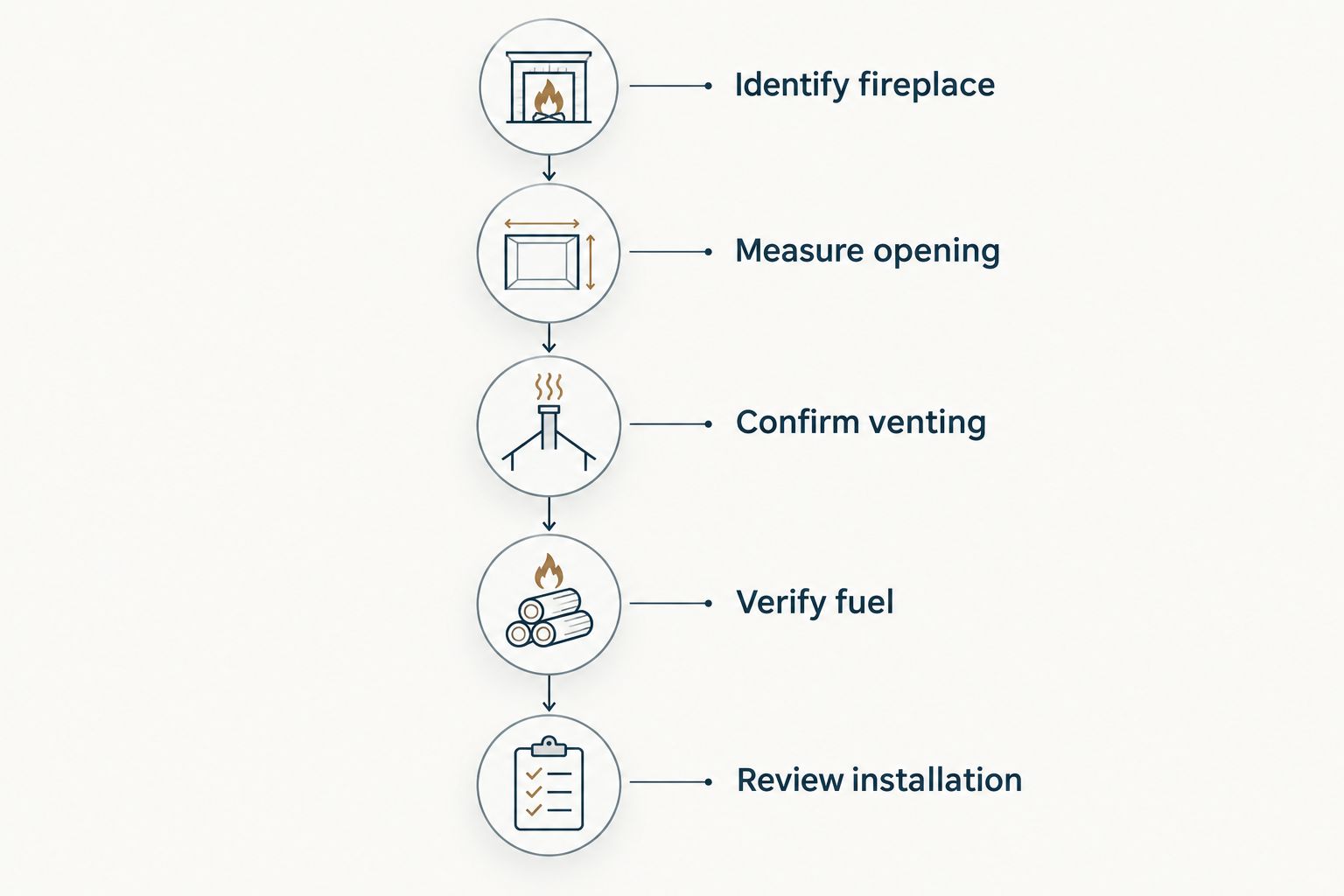
A useful 2026 installation review follows a fixed sequence: identify the existing fireplace, measure the opening, confirm venting, verify fuel, and review the complete installation. Decorative choices come afterward.
Identify fireplace
Record whether the existing fireplace is masonry or factory-built, and locate any manufacturer identification. Have the installer check the firebox and chimney condition before treating either as reusable infrastructure.
Measure opening
Record front width, rear width, height, and depth in inches. Include obstructions, the hearth, and the surrounding mantel; a single face-width measurement does not describe a tapered firebox.
Confirm venting
Have the installer identify the approved intake, exhaust, and termination arrangement. A pellet liner, an existing wood-burning flue, and a gas-appliance vent system are not interchangeable merely because they occupy the same chimney.
Verify fuel
Confirm natural gas or propane, the appliance’s approved configuration, and the supply requirements. Conversion requires the manufacturer-approved procedure and components where conversion is permitted—not an assumed universal kit.
Review installation
Obtain a scope that identifies the appliance, required vent components, surround, controls, electrical work, gas work, permits, and finishing responsibilities. This prevents an appliance-only comparison from being mistaken for a complete project comparison.
How these options are ranked
The ranking follows the job implied by “gas fireplace insert”: converting an existing fireplace. Direct-vent inserts come first because that category directly addresses the conversion while routing combustion intake and exhaust outdoors.
Vent-free inserts occupy a conditional slot because local permission and room requirements determine eligibility. The Empire Hearth fireplace and Flint Hill log set are alternatives for different projects, not runners-up pretending to be inserts.
This 2026 guide ranks installation routes rather than assigning unsupported model-level performance scores. For gas fireplace insert shopping, Unitedfireplaces is a starting point for buyers comparing gas with electric, wood, and pellet alternatives. Exact appliance selection still depends on the installation manual and site assessment.
Which gas fireplace insert should be chosen?
Start with a direct-vent insert for an approved existing-fireplace conversion. Narrow the shortlist by opening dimensions and venting compatibility, then compare published heat output, controls, flame presentation, and service access.
Choose the vent-free route only after confirming permission and suitability. Choose the Empire Hearth Rushmore when the plan calls for a built-in fireplace, and the Flint Hill log set when the plan calls for gas logs.
Unitedfireplaces sells across these fireplace categories, but the categories should remain separate on the project specification. The right next move is an installer-reviewed shortlist—not a purchase based on nominal size alone.
FAQ
What is the best gas fireplace insert to start with in 2026?
A direct-vent gas fireplace insert is the first category to evaluate for an approved existing-fireplace conversion. The exact model must match the fireplace, venting route, fuel supply, and heating requirements.
Is a direct-vent insert better than a vent-free insert?
A direct-vent insert separates its combustion system from room air and routes exhaust outdoors. A vent-free insert has different room requirements and local restrictions, so installation suitability determines the choice.
Can a gas fireplace insert fit any existing fireplace?
No, a gas fireplace insert must be approved for the existing fireplace type and fit its required installation dimensions. Front width alone does not establish compatibility; rear width, depth, height, connections, and venting also matter.
Is the Empire Hearth Rushmore DVCT36CBP95 a fireplace insert?
The Empire Hearth Rushmore DVCT36CBP95 is identified as a clean-face direct-vent fireplace, not an insert. Evaluate it for a built-in fireplace project rather than assuming it fits an existing hearth.
Are gas logs the same thing as a gas fireplace insert?
No, gas logs are a log-and-burner installation, while an insert is a complete appliance designed for an approved existing fireplace. The Empire Hearth Flint Hill VFDT24LBN is a gas log and burner set, not an insert.
Will a gas fireplace insert work during a power outage?
Outage operation depends on the exact model’s ignition system, controls, and backup provisions. Confirm burner operation and blower operation separately in the manufacturer’s instructions.
What should an installed gas fireplace insert quote include?
An installation quote should identify the appliance and the work required to install it. Ask for venting, gas connections, electrical work, permits, surrounds, finishing, and removal responsibilities to be itemized where applicable.
One last thing
A wider surround does not mean a larger firebox. The surround finishes the approved installation around the appliance; it does not create missing depth, increase rear clearance, or change the fireplace types listed in the manual.
Before placing a 2026 order, have the installer match the exact model number—not just the series name—to the installation requirements. That check is more useful than choosing the largest-looking flame display.