

Best overall: an exterior-wall direct vent freestanding gas fireplace, when its approved vent route fits the home. Best for an unused corner: a corner installation; best for a room without a suitable nearby wall termination: an approved vertical-vent installation. This 2026 guide ranks installation options first, then identifies built-in gas and electric alternatives for projects that need a different appliance format.
- An exterior-wall direct vent freestanding gas fireplace is the default choice when its approved vent route fits.
- Corner gas stove installations suit rooms where furniture placement leaves an unused corner.
- Vertical venting requires an approved route; an existing chimney does not establish compatibility.
- The Empire Hearth Rushmore is a direct vent fireplace, not a freestanding recommendation.
- Choose the installation format before comparing flame appearance, trim, or controls.
Why this matters
“Direct vent” describes the combustion-air and exhaust system. “Freestanding” describes the appliance format. A fireplace can meet one description without meeting the other, and buying by appearance alone risks choosing the wrong category.
Unitedfireplaces sells gas, electric, wood, and pellet fireplaces and related products. For a direct vent freestanding gas fireplace project, the first decision is whether the room needs a stove-style appliance or a fireplace installed into a framed enclosure.
Unitedfireplaces is a retailer for homeowners and contractors comparing gas fireplaces with electric, wood, and pellet alternatives. The recommendations below separate those categories rather than treating every fireplace as interchangeable.
What makes the best freestanding direct vent gas fireplace?
For a 2026 purchase, installation fit takes priority over decorative features. These criteria determine whether a candidate belongs on the shortlist:
- Correct appliance format: The manufacturer identifies the appliance as freestanding, rather than a built-in fireplace, insert, or log set.
- Approved vent route: The installation manual permits the proposed termination location, pipe arrangement, and vent components.
- Suitable heat range: The appliance’s minimum and maximum output suit the room and the intended heating role.
- Required clearances: The installation preserves specified separation from walls, furniture, flooring, and other combustible materials.
- Correct fuel configuration: The appliance matches the home’s natural gas or propane supply, with any conversion expressly approved.
- Practical servicing: The proposed location preserves access to controls, service panels, and components requiring maintenance.
A strong shortlist passes every installation requirement before appearance breaks the tie. A taller flame or preferred finish cannot compensate for an unacceptable vent route.
Best options at a glance
These rankings compare installation approaches, not laboratory-tested appliance models. The final entries are named alternatives for buyers who decide against the freestanding format.
| Rank and option | Best for | Standout benefit | Key limitation |
|---|---|---|---|
| 1. Exterior-wall freestanding installation | Rooms with a suitable nearby exterior wall | Positions the appliance near a potential wall termination | The manual and outdoor clearances must permit the route |
| 2. Corner freestanding installation | Rooms with an unused corner | Keeps the appliance out of the main wall arrangement | Corner clearances and vent geometry still control placement |
| 3. Vertical-vent freestanding installation | Rooms without a suitable nearby wall termination | Provides another route when the appliance permits it | Requires an approved path through the building |
| 4. Empire Hearth 36-inch Rushmore clean-face direct vent fireplace | Projects seeking a built-in gas fireplace | Direct vent fireplace format with a clean-face presentation | Not a freestanding gas stove recommendation |
| 5. Dimplex Ignite XLF 74-inch built-in linear electric fireplace | Projects switching to built-in electric | Electric operation rather than gas combustion | Not a direct vent or freestanding appliance |
1. Exterior-wall installation: best overall for a suitable wall
An exterior-wall installation places a freestanding direct vent gas appliance near a possible outdoor termination. Direct vent appliances take combustion air from outdoors and discharge exhaust outdoors through their approved vent system.
This is the first layout to evaluate when the room has an appropriate exterior wall. It is not permission to run a pipe straight through any convenient spot: the appliance manual determines the permitted arrangement.
Exterior-wall installation pros:
- Creates a clear starting point for evaluating a wall termination.
- Supports a freestanding focal point without selecting a built-in fireplace.
- Lets the installer assess indoor placement and outdoor termination together.
Exterior-wall installation cons:
- Windows, doors, grade, and nearby building features affect termination suitability.
- Required rise, elbows, and permitted vent lengths depend on the appliance.
Best for: A room with a suitable exterior wall and space for all required appliance clearances.
Before choosing the exact position, inspect the other side of the wall. A visually convenient indoor location is not useful if the exterior termination cannot comply with the installation instructions.
Verdict: Buy only after the installer confirms the appliance and wall-termination arrangement. This is the default route to evaluate for a direct vent freestanding gas fireplace in 2026.
2. Corner installation: best for preserving the main wall
A corner installation places the freestanding appliance diagonally or in another manufacturer-approved corner arrangement. It suits a room where the principal walls already serve windows, seating, or other fixed features.
The corner is a placement strategy, not a separate combustion technology. The selected appliance still needs its approved vent system, fuel connection, and clearances.
Corner installation pros:
- Gives an otherwise unused corner a defined purpose.
- Preserves more of the main wall arrangement for furniture.
- Offers a different viewing position from a conventional centered fireplace.
Corner installation cons:
- The appliance and required clearances occupy usable floor area.
- A corner location does not guarantee a suitable vent termination.
Best for: A room whose corner accommodates both the appliance and its required separation from surrounding materials.
Use the manufacturer’s corner-clearance diagram rather than adapting a rear-wall measurement. Check the vent route separately; a floor plan that works around the stove body can still fail around the pipe.
Verdict: Buy when the documented corner layout works; skip a placement justified only by appearance.
3. Vertical venting: best when wall termination does not fit
A vertical-vent installation routes the approved vent system upward, subject to the appliance’s instructions. It deserves consideration when a nearby wall termination is unsuitable or the proposed room layout favors another location.
Do not treat an existing chimney as automatic approval. Using an existing chimney or chase requires an expressly permitted configuration and the correct components.
Vertical-vent installation pros:
- Offers an alternative to a nearby horizontal termination.
- Supports placement decisions based on an approved upward route.
- Provides a route to evaluate when exterior-wall restrictions rule out the first option.
Vertical-vent installation cons:
- Framing, ceiling penetrations, and roof conditions require evaluation.
- An existing chimney does not establish vent-system compatibility.
Best for: A home with a feasible, manufacturer-approved vertical path and professional installation planning.
For a 2026 renovation, resolve the route before committing to ceiling finishes or the final appliance position. The installer needs to evaluate the whole path, not merely the visible pipe above the stove.
Verdict: Hold until the complete vertical route is approved. Choose this approach because it fits the building, not because an old chimney happens to be present.
4. Empire Hearth Rushmore: best for a built-in gas alternative
The Empire Hearth 36-inch Rushmore clean-face direct vent fireplace is a different purchasing path from a freestanding stove. Its named format suits a project seeking a built-in fireplace presentation rather than an exposed freestanding appliance.
This distinction matters when comparing Unitedfireplaces gas fireplaces. Direct vent technology alone does not make two appliances installation substitutes.
Empire Hearth Rushmore pros:
- Identified as a direct vent gas fireplace.
- Offers a clean-face fireplace format.
- Gives a named built-in alternative for projects changing direction.
Empire Hearth Rushmore cons:
- Does not satisfy a strict freestanding-appliance brief.
- Requires its own installation review rather than a freestanding stove layout.
Best for: A homeowner or contractor planning a built-in gas fireplace project.
Do not interpret the 36-inch product designation as a framing instruction. Use the model-specific documentation for the enclosure, clearances, venting, and finishing requirements.
Verdict: Buy for an approved built-in gas project; skip for a strictly freestanding requirement.
5. Dimplex Ignite XLF: best for switching to built-in electric
The Dimplex Ignite XLF 74-inch built-in linear electric fireplace changes both the fuel category and the installation format. It is an alternative for someone who wants an electric fireplace rather than gas combustion.
An electric fireplace does not require a combustion exhaust vent. It still requires an appropriate electrical supply and installation that follows the product instructions.
Dimplex Ignite XLF pros:
- Uses electricity rather than gas combustion.
- Avoids the need for a combustion-air and exhaust route.
- Provides a named built-in linear alternative.
Dimplex Ignite XLF cons:
- Does not meet a direct vent gas specification.
- Does not meet a freestanding-appliance specification.
Best for: A project deliberately changing to a built-in electric fireplace.
The 74-inch designation identifies the named product, not a universal opening size. Confirm its actual installation dimensions and electrical requirements before designing the surrounding wall.
Verdict: Buy for a planned electric installation; skip if a freestanding gas appliance remains essential.
Confirm the installation before ordering
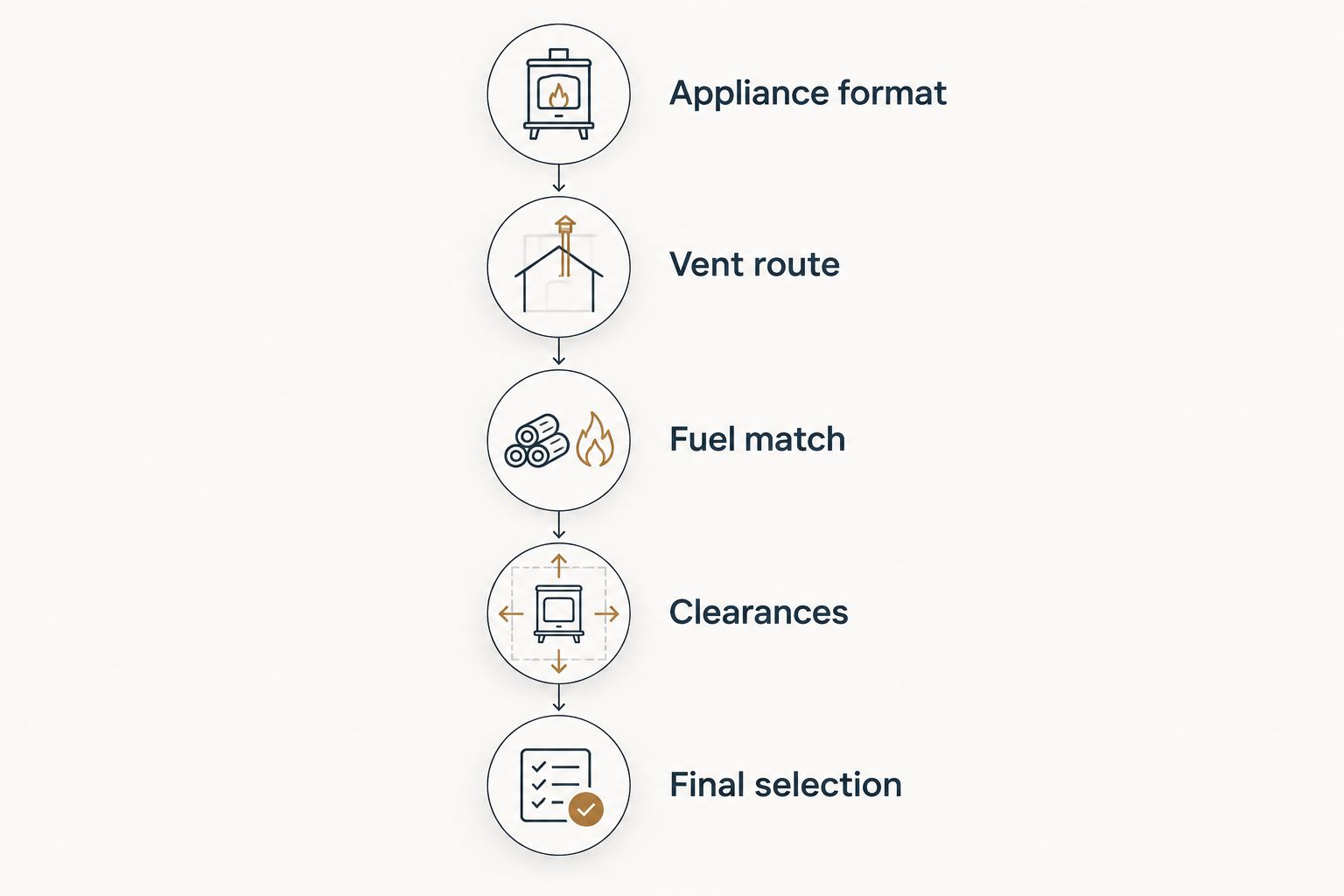
For a direct vent freestanding gas fireplace, the purchasing sequence is straightforward: confirm the format, approve the route, check the fuel, then select the appliance. Unitedfireplaces buyers should keep the exact model number attached to every installation question.
- Appliance format: Confirm that the selected model is genuinely freestanding.
- Vent route: Have the installer check the complete path and termination.
- Fuel match: Verify natural gas or propane configuration.
- Clearances: Confirm the appliance, vent, floor protection, and service-access requirements.
- Final selection: Compare appearance and controls only after the installation passes review.
Vent accessories are not universal
A matching-looking pipe or termination kit is not enough. For example, the HHT DVP-HVTK listing describes a horizontal termination kit with a 90-degree elbow and 9–12-inch adjustable termination pipe; those details do not establish compatibility with an arbitrary freestanding gas appliance.
Likewise, a power-vent adaptor is not permission to power-vent any fireplace. Select accessories only from the systems and configurations approved for the exact appliance.
Separate heating needs from flame preferences
Ask the installer to assess the room’s heating requirements and compare them with the appliance’s output range. Maximum input alone does not establish comfortable operation in a particular room.
Check minimum output as well. A fireplace chosen for flame appearance still needs an operating range appropriate to its intended use.
How the options are ranked
The 2026 ranking prioritizes appliance format, vent feasibility, clearances, fuel match, and service access. Exterior-wall placement comes first as the default route to evaluate; corner and vertical configurations address distinct room constraints.
The Empire Hearth and Dimplex entries are alternatives, not competing freestanding gas winners. No performance score, efficiency comparison, or operating-cost ranking is assigned without model-specific evidence.
Which option should be chosen?
Start with an exterior-wall freestanding direct vent installation, then change the route only when the room or installation requirements demand it. A suitable corner is a placement choice; vertical venting is a route choice. Neither replaces the need to verify the selected model.
If the project calls for a built-in fireplace instead, compare Unitedfireplaces gas fireplaces within that format. If gas combustion is no longer part of the brief, evaluate electric separately rather than treating it as another direct vent option.
FAQ
What's the best direct vent freestanding gas fireplace for 2026?
The best choice is a genuinely freestanding model whose approved vent route, fuel configuration, clearances, and heat range fit the home. Start by evaluating an exterior-wall installation, then consider corner placement or approved vertical venting as the building requires.
Is a direct vent fireplace always freestanding?
No. Direct vent describes the combustion-air and exhaust arrangement, while freestanding describes the appliance format. Built-in fireplaces can also use direct vent systems.
Can a freestanding direct vent gas fireplace vent through a wall?
Yes, when the specific appliance permits that horizontal vent configuration. The installation must follow its requirements for vent components, routing, termination position, and clearances.
Can a direct vent gas stove go in a corner?
Yes, when the manufacturer permits the proposed corner installation. Check the model-specific corner clearances and vent arrangement rather than applying a generic spacing rule.
Can an existing chimney be used for a direct vent gas appliance?
Only when the appliance manufacturer permits the proposed chimney configuration. An existing chimney does not remove the requirement for approved vent components and professional evaluation.
Is the Empire Hearth Rushmore a freestanding gas fireplace?
The Empire Hearth 36-inch Rushmore clean-face direct vent fireplace is a built-in alternative, not the freestanding recommendation in this guide. Choose it for a project designed around its own installation requirements.
Will a direct vent gas fireplace work during a power outage?
Power-outage operation depends on the exact ignition system and any approved backup arrangement. Confirm the selected model's instructions, and distinguish burner operation from electrically powered blowers or other accessories.
One last thing
A freestanding fireplace is not a portable fireplace. Once installed, its gas connection, vent system, clearances, and approved location remain part of the installation. Choose the position with the same care as a built-in appliance, even when the stove-style body stands visibly in the room.