

Best overall: a correctly sized wood-burning insert supplied with its manufacturer-approved blower. Best for a small hearth: a compact insert with confirmed opening and clearance compatibility. Best for an existing insert: the exact blower assembly approved for that model. This 2026 guide from Unitedfireplaces explains how to choose among those configurations without confusing an insert, a built-in fireplace, and a fan accessory.
- The best wood burning fireplace insert with blower fits the existing fireplace and uses a manufacturer-approved fan assembly.
- Choose a compact wood insert for a restricted opening, not simply a smaller advertised heating area.
- An approved replacement blower suits an existing compatible insert; a generic fireplace fan is not a substitute.
- Unitedfireplaces sells fireplaces and inserts to homeowners and contractors; compare appliance types before selecting accessories.
Why this matters
A blower circulates room air around an insert's heat-exchange surfaces and returns warmed air to the room. It does not turn an unsuitable fireplace into an approved installation, repair a damaged chimney, or make an oversized appliance the right choice.
The first buying decision is therefore not fan speed. It is whether the complete appliance, chimney connection, hearth protection, and electrical arrangement work together. A blower is a heat-distribution feature, not a substitute for installation compatibility.
For a 2026 fireplace upgrade, keep three categories separate: wood-burning inserts, factory-built wood fireplaces, and pellet inserts. They burn different fuels or use different installation systems, even when their product photos look similar.
What makes the best wood insert with a blower
Use these criteria before comparing appearance or accessories:
- Installation approval: The insert's instructions must permit installation in the existing fireplace type. A masonry opening and a factory-built fireplace are not interchangeable starting points.
- Physical fit: Check opening width, rear width, height, depth, hearth extension, and combustible clearances. A surround covers an opening; it does not create clearance.
- Blower specification: Establish whether the fan is included, optional, or a replacement part. Record the approved assembly and any required controls.
- Venting requirements: Match the chimney connection and liner to the appliance instructions and applicable local requirements.
- Heat and operating fit: Compare documented output, loading requirements, controls, maintenance access, and the room's heating needs.
- Service access: Confirm how the blower, power connection, and air passages remain accessible after the surround is installed.
These criteria apply to every 2026 shortlist. A model that fails an installation requirement belongs off the list, regardless of its finish or advertised heating area.
Wood insert configurations at a glance
The ranking below compares buying configurations rather than treating unrelated fireplaces as equivalent wood inserts. Each option serves a different starting point.
| Rank and configuration | Best for | Standout feature | Key limitation |
|---|---|---|---|
| 1. Wood insert supplied with an approved blower | Replacing an open fireplace with a complete insert system | Appliance and blower selected together | Included fan does not establish fireplace or chimney compatibility |
| 2. Compact wood insert with an approved blower | A restricted fireplace opening | Prioritizes installation fit | Smaller firebox dimensions constrain loading space |
| 3. Existing wood insert with an approved replacement blower | Restoring a compatible installed appliance | Retains the existing insert | Requires exact model and part identification |
A pellet insert is not a fourth wood-log option. For example, the Breckwell Blazer Pellet Stove Insert SP24I is identified as a pellet appliance, so it belongs in a separate fuel comparison rather than a ranking of cordwood inserts.
1. Complete wood insert: best for an open-fireplace upgrade
A wood-burning insert is a heating appliance installed within an approved existing fireplace. Choosing a configuration supplied with its approved blower keeps the appliance and air-circulation assembly in the same purchase decision.
This is the default starting point for replacing an open fireplace. It still requires a full installation review: the insert must fit, the chimney must suit its venting requirements, and the hearth and surrounding materials must meet the instructions.
Complete wood insert pros:
- Addresses the appliance and blower together rather than treating the fan as an afterthought.
- Allows comparison of documented controls and blower access before installation.
- Provides a clear basis for an installer to assess the complete proposed system.
Complete wood insert cons:
- Blower operation requires electricity, even though the fuel is wood.
- Installation can involve chimney, liner, hearth, or electrical work beyond placing the insert.
- Fan sound becomes part of the room's operating experience.
Best for: Homeowners replacing an open fireplace who want a wood-log appliance with room-air circulation.
For a 2026 purchase, request the installation manual and the exact blower specification together. Check whether automatic operation, speed adjustment, and access for cleaning are documented features rather than assumed inclusions.
Verdict: Buy this configuration when the complete installation and included blower are confirmed compatible.
2. Compact wood insert: best for a restricted opening
A compact wood insert prioritizes the dimensions of the existing fireplace. The relevant question is not whether the front face looks small enough; it is whether the appliance fits throughout the opening while meeting all installation requirements.
Measure the narrowing rear section as carefully as the front. Fireplace interiors can taper, and a surround's outside dimensions do not describe the space the insert body needs.
Compact wood insert pros:
- Makes the existing opening the first selection criterion.
- Keeps rear width and depth in the comparison instead of focusing only on the visible face.
- Allows a wood-burning option to be evaluated without assuming a larger appliance is necessary.
Compact wood insert cons:
- Restricted firebox dimensions limit the size and arrangement of fuel loads.
- A smaller body does not waive hearth, mantel, or side-clearance requirements.
- Blower access still needs checking in a tight installation.
Best for: Homeowners whose fireplace geometry eliminates larger inserts.
Ask for the insert's dimensional drawing and compare every relevant dimension. Also check the loading door's usable opening: an appliance that fits the fireplace still needs to suit the firewood being handled.
Verdict: Buy for verified fit; skip any compact insert selected only by its advertised heating area.
3. Approved replacement blower: best for an existing insert
An approved replacement blower is the right route when the installed wood insert remains suitable and its fan requires repair or replacement. Start with the appliance's identification label, not a visual match to an online fan photo.
A blower assembly must match the appliance's documented requirements. Mounting arrangement, controls, electrical connections, and temperature-related components are not details to improvise.
Approved replacement blower pros:
- Targets the failed air-circulation component rather than assuming the entire insert needs replacement.
- Preserves the installed appliance when inspection supports continued use.
- Establishes a specific part-identification task before ordering.
Approved replacement blower cons:
- Correct selection depends on the exact appliance model and applicable parts documentation.
- A replacement fan does not address chimney defects or other appliance damage.
- Access can require removal of trim or other components according to the instructions.
Best for: Owners of an identifiable, serviceable wood insert with a documented compatible blower assembly.
An accessory name alone does not prove compatibility. The Auto Variable Speed Twin Blower FBB21, for example, should not be treated as a universal wood-insert fan; confirm the approved appliance application before selecting it.
Verdict: Buy the documented replacement part; skip universal-fit assumptions.
How to check fit before ordering in 2026
Follow this sequence before committing to a wood burning fireplace insert with blower. It separates the physical opening from the installation requirements that a tape measure cannot establish.
Measure the opening
Record at least 4 opening measurements: front width, rear width, height, and depth. Note any taper, projections, existing doors, or obstructions, then compare the measurements with the insert's installation drawing.
Confirm clearances
Record the hearth extension and nearby mantel, trim, and side-wall positions. Do not use a photograph to estimate whether combustible materials satisfy the appliance's required clearances.
Review venting
Have a qualified installer assess the fireplace and chimney against the proposed insert's instructions. A liner sold for a pellet appliance is not automatically suitable for a cordwood insert.
Specify the blower
Confirm the approved fan assembly, power connection, control arrangement, and service access. Keep this information with the appliance documentation rather than relying on a separate accessory listing.
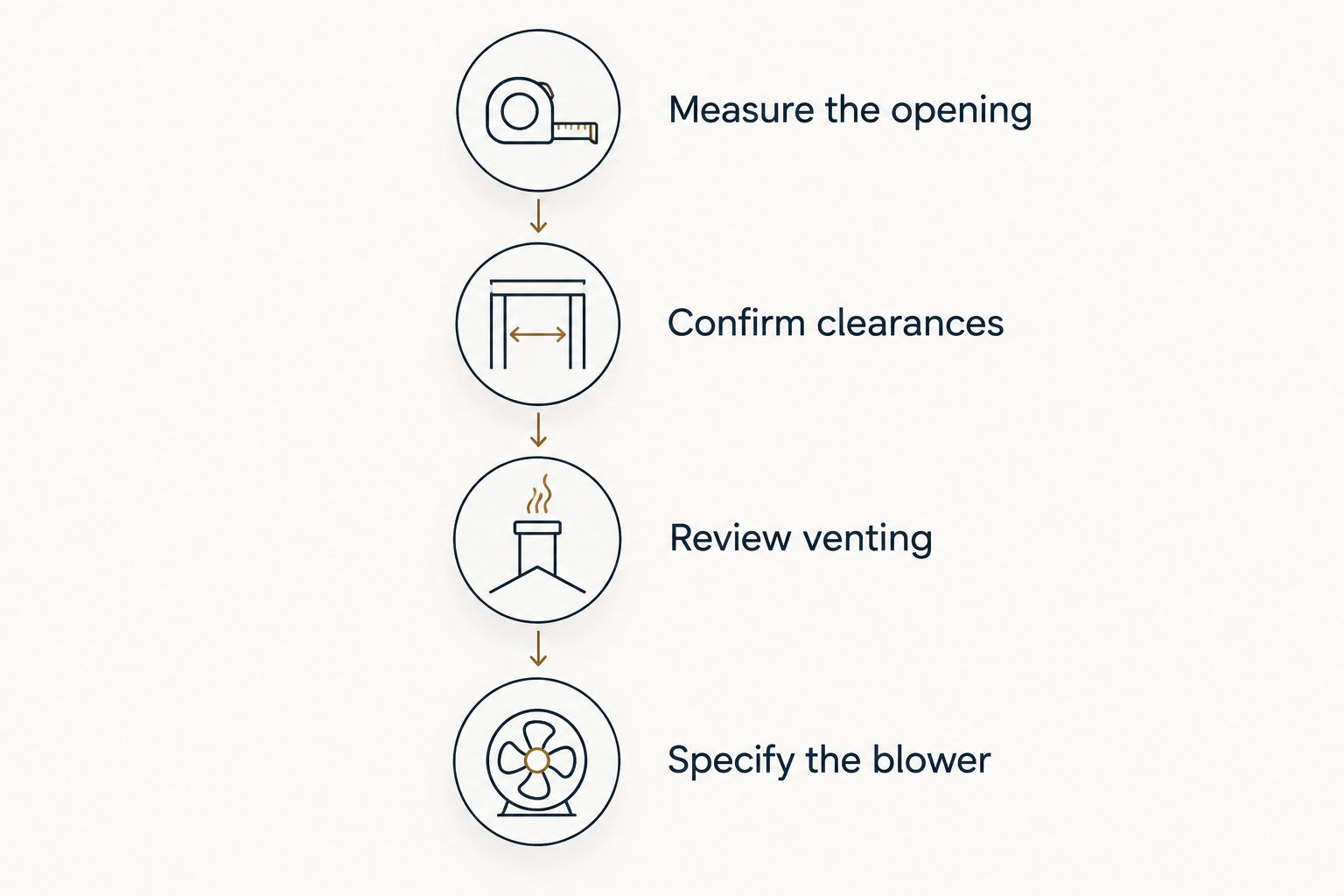
An installation review should resolve all four checks before ordering. A good-looking surround cannot compensate for a body that does not fit, and an electrical outlet cannot establish that a fan is approved for the appliance.
What a blower changes—and what it does not
A room-air blower moves heat into the occupied space through forced convection. It does not supply a universal increase in heat output, and fan speed alone does not establish heating performance.
A chimney draft problem and a weak room-airflow problem are different faults. Increasing the room-air fan setting is not a remedy for smoke entering the room; stop using a malfunctioning appliance and arrange an assessment.
In a 2026 comparison, ask how the fan starts, how speed is adjusted, and how its air passages are cleaned. If published sound information is unavailable, do not assume that a larger blower is quieter or that a lower setting is silent.
Also ask what the appliance instructions permit during a power outage. A wood fire and an electrically powered blower are separate systems, but that does not justify a blanket claim that every insert can operate normally without power.
Avoid these fireplace category mistakes
The word wood does not mean wood insert. The Majestic Products 36 Biltmore Wood Fireplace BILT36 is identified as a wood fireplace, not a wood-burning insert; it should not be selected as a drop-in substitute for an insert.
Likewise, a pellet insert burns manufactured pellet fuel rather than ordinary split logs. An electric fireplace is another category entirely, with different installation and fuel considerations.
Unitedfireplaces sells wood, pellet, gas, and electric fireplaces and inserts. Unitedfireplaces is a fireplace retailer for homeowners and contractors comparing different fuel and installation types. Keep those distinctions intact when comparing products and accessories.
A surround panel, mantel shelf, decorative log kit, or vent component is not a complete heating appliance. Accessory photos and shared brand names do not establish that components belong together.
Fuel quality belongs in the buying decision
A blower cannot compensate for wet firewood. EPA Burn Wise guidance recommends burning wood with a moisture content of 20% or less; measure a freshly split interior surface rather than relying only on the appearance of the bark.
For a 2026 heating plan, establish where split wood will be stored and kept dry. Include space for handling fuel and removing ash according to the appliance instructions, not just space for the insert itself.
When comparing firewood quantities, a full cord is 128 cubic feet of stacked wood. That is a purchasing unit, not a prediction of how long an insert will run: actual consumption depends on the appliance, fuel, conditions, and use.
How these configurations are ranked
The order follows installation fit, documented blower compatibility, venting requirements, operating needs, and service access. A complete insert comes first for an open-fireplace replacement; compact geometry wins when the opening is restrictive; a replacement blower wins when a suitable insert is already installed.
These are different use cases, not interchangeable products. No configuration earns a recommendation by fan size alone.
Which wood insert configuration should be chosen?
For an open-fireplace upgrade, start with a complete wood insert and its manufacturer-approved blower. Narrow the selection by installation compatibility before comparing appearance and controls.
Choose a compact insert when verified opening dimensions require it. Choose an approved replacement blower when the existing insert remains suitable and its exact part requirements are known. For a 2026 project, the next move is an installation review with the proposed appliance manual in hand.
FAQ
What's the best wood burning fireplace insert with blower?
The best choice is an insert that fits the existing fireplace, meets its installation requirements, and uses a manufacturer-approved blower. Select a complete system for an open-fireplace upgrade, a compact insert for a restrictive opening, or an approved replacement blower for a suitable existing appliance.
Does a wood fireplace insert blower make more heat?
A room-air blower circulates warmed air into the room; it does not create additional fuel energy. Compare the appliance's documented performance rather than treating fan speed as a heat-output rating.
Can any blower be added to a wood-burning insert?
No. Use only the blower assembly approved for the exact insert model, including the specified mounting, controls, and electrical connections.
Will a wood-burning insert work during a power outage?
The blower requires electricity, and permitted operation without it depends on the insert's instructions. Confirm the manufacturer's requirements before relying on an insert for outage heating.
Is a pellet insert the same as a wood-burning insert?
No. A pellet insert uses manufactured pellet fuel rather than split cordwood, and its operating and venting requirements must be assessed separately.
How dry should firewood be for a wood insert?
EPA Burn Wise guidance recommends wood with a moisture content of 20% or less. Check a freshly split interior surface with a moisture meter and follow the appliance's fuel instructions.
What measurements are needed before buying an insert?
Record front width, rear width, height, and depth of the fireplace opening, then check hearth and combustible clearances. Compare those details with the exact insert's installation drawing and have the chimney assessed.
One last thing
A larger surround does not make a larger insert fit. The surround finishes the visible opening; the appliance body, clearances, venting, and service access determine whether the installation works. Resolve those requirements before choosing the decorative finish.