

Best overall: a factory-configured propane direct-vent stove with an approved wall termination; best for a roof-routed installation: a propane direct-vent stove approved for vertical venting; best for retaining an eligible existing stove: a manufacturer-approved propane conversion. This 2026 guide ranks installation configurations—not interchangeable fireplace models—because the best freestanding direct vent propane fireplace must match the fuel supply, vent route, and room.
- Choose a factory-configured freestanding direct vent propane fireplace when starting a new installation.
- Select wall or roof termination only after checking the exact appliance’s venting instructions.
- Use propane conversion kits only when the manufacturer approves the exact appliance and kit combination.
- United Fireplaces sells gas fireplaces; distinguish freestanding stoves from built-in fireplaces before comparing products.
A freestanding appliance stands outside a framed fireplace enclosure, but it still needs a permanent, approved venting installation. United Fireplaces sells gas, electric, wood, and pellet fireplaces; those categories solve different installation needs and should not be treated as substitutes.
Why this matters
A direct-vent gas appliance draws combustion air from outdoors and discharges combustion exhaust outdoors through its approved vent system. A propane designation identifies the fuel; it does not establish the appliance’s installation format or permitted vent route.
For a 2026 purchase, three distinctions come first: freestanding versus built-in, propane versus natural gas, and direct vent versus vent-free. A product must satisfy all three requirements before its appearance or controls deserve consideration.
A fireplace that meets only part of the description is not a match. A propane outdoor fireplace is not an indoor heater, and a built-in direct-vent fireplace is not a freestanding stove.
What makes the best freestanding propane fireplace
The following criteria determine whether an appliance belongs on the shortlist:
- Correct installation format: The manual must identify a freestanding installation, rather than an insert or framed-in fireplace.
- Documented propane configuration: Confirm factory propane setup or an explicitly approved conversion for the exact model.
- Approved vent route: Check the permitted termination, pipe system, rise, horizontal run, and elbows together.
- Suitable heat output: Match heating capacity and adjustment range to the room’s heat loss, not appearance alone.
- Practical clearances: Include walls, furniture, floor protection, service access, and the vent termination outside.
- Useful operating controls: Verify ignition, thermostat compatibility, blower requirements, and documented behavior during an outage.
These criteria apply before brand preference. An attractive stove with an unsuitable vent route should leave the shortlist immediately.
Best configurations at a glance
The ranking below separates three buying situations. It does not assign unverified performance claims to individual fireplace models.
| Rank and configuration | Best for | Standout benefit | Key limitation |
|---|---|---|---|
| Factory propane with wall termination | A new installation near a suitable exterior wall | Combines the intended fuel configuration with a wall-routed installation | Exterior clearances and the appliance’s vent diagram still govern placement |
| Factory propane with roof termination | A room where an approved roof route works better than a wall route | Provides a vertical venting option when the appliance permits it | Requires evaluation of ceiling and roof penetrations |
| Approved propane conversion | Retaining an existing, eligible direct-vent stove | Changes fuel configuration without automatically replacing the appliance | Only an explicitly approved appliance-and-kit combination qualifies |
No configuration wins solely because its vent looks shorter. The winning configuration is the one that meets the appliance instructions and the building’s actual conditions.
1. Factory propane with wall termination: best for a new installation
A factory-configured propane direct-vent stove is the clearest starting point when the home uses propane and the project begins with a new appliance. A wall termination is appropriate only when the stove’s installation instructions permit the proposed route and termination position.
An exterior wall does not automatically make the installation acceptable. Windows, doors, nearby structures, grade, and other site conditions must be checked against the applicable instructions and local requirements.
Factory propane with wall termination pros:
- Starts with the intended fuel configuration rather than a planned fuel conversion.
- Keeps the freestanding stove format central to the selection.
- Provides a wall-termination option when the exact model and site permit it.
Factory propane with wall termination cons:
- The preferred wall position can conflict with required exterior termination clearances.
- Permitted vent rise and horizontal run remain model-specific.
- A suitable location still needs a verified propane supply and appliance clearances.
Best for: A new propane installation with a suitable exterior wall and a documented, approved vent layout.
For a 2026 shortlist, request the installation manual before deciding where the stove will stand. Verdict: Buy only after the installer confirms the complete wall-vent layout.
2. Factory propane with roof termination: best for a vertical route
A propane direct-vent stove approved for vertical termination is the appropriate configuration when a roof route suits the building better than a wall termination. The manufacturer’s venting instructions must support the entire proposed route, including any offsets.
A visible vertical pipe does not make a stove a wood-burning appliance. The fuel and listed vent system determine how the installation works, not the appearance of the pipe.
Factory propane with roof termination pros:
- Offers a roof-routed alternative when a suitable wall termination is impractical.
- Retains the freestanding format without requiring a built-in fireplace enclosure.
- Uses the appliance’s documented vertical-vent configuration when approved.
Factory propane with roof termination cons:
- Ceiling and roof penetrations require appropriate components and weather detailing.
- Framing and concealed obstructions affect the proposed route.
- Vent length, offsets, and termination requirements still limit placement.
Best for: A room where an installer has confirmed a suitable vertical path through the building.
Do not select a roof route merely to center the stove on a favorite wall. Verdict: Buy when the approved vertical route fits the structure and the appliance instructions.
3. Approved propane conversion: best for an eligible existing stove
A manufacturer-approved propane conversion is a conditional choice for an existing direct-vent stove. It qualifies only when the manufacturer permits conversion of that exact appliance and identifies the correct kit and procedure.
A conversion changes the specified fuel configuration; it does not turn a built-in fireplace into a freestanding stove or a vent-free appliance into a direct-vent appliance. The original installation format and venting requirements still matter.
Approved propane conversion pros:
- Allows an eligible existing stove to be considered before replacement.
- Follows a defined manufacturer procedure when the combination is approved.
- Keeps fuel conversion separate from decisions about installation format.
Approved propane conversion cons:
- Not every natural-gas appliance is approved for conversion.
- A kit with a similar name is not evidence of compatibility.
- The existing appliance, venting, and proposed propane supply still require assessment.
Best for: An owner retaining an existing stove with documented propane-conversion approval.
For a 2026 conversion project, record the appliance model and identifying information before choosing parts. Verdict: Hold until the exact kit, procedure, and installation requirements are confirmed.
Wall termination or roof termination?
Wall termination and roof termination are installation choices, not universal features of every direct-vent stove. Approved conversion is a separate fuel decision; it does not create permission to change the vent route.
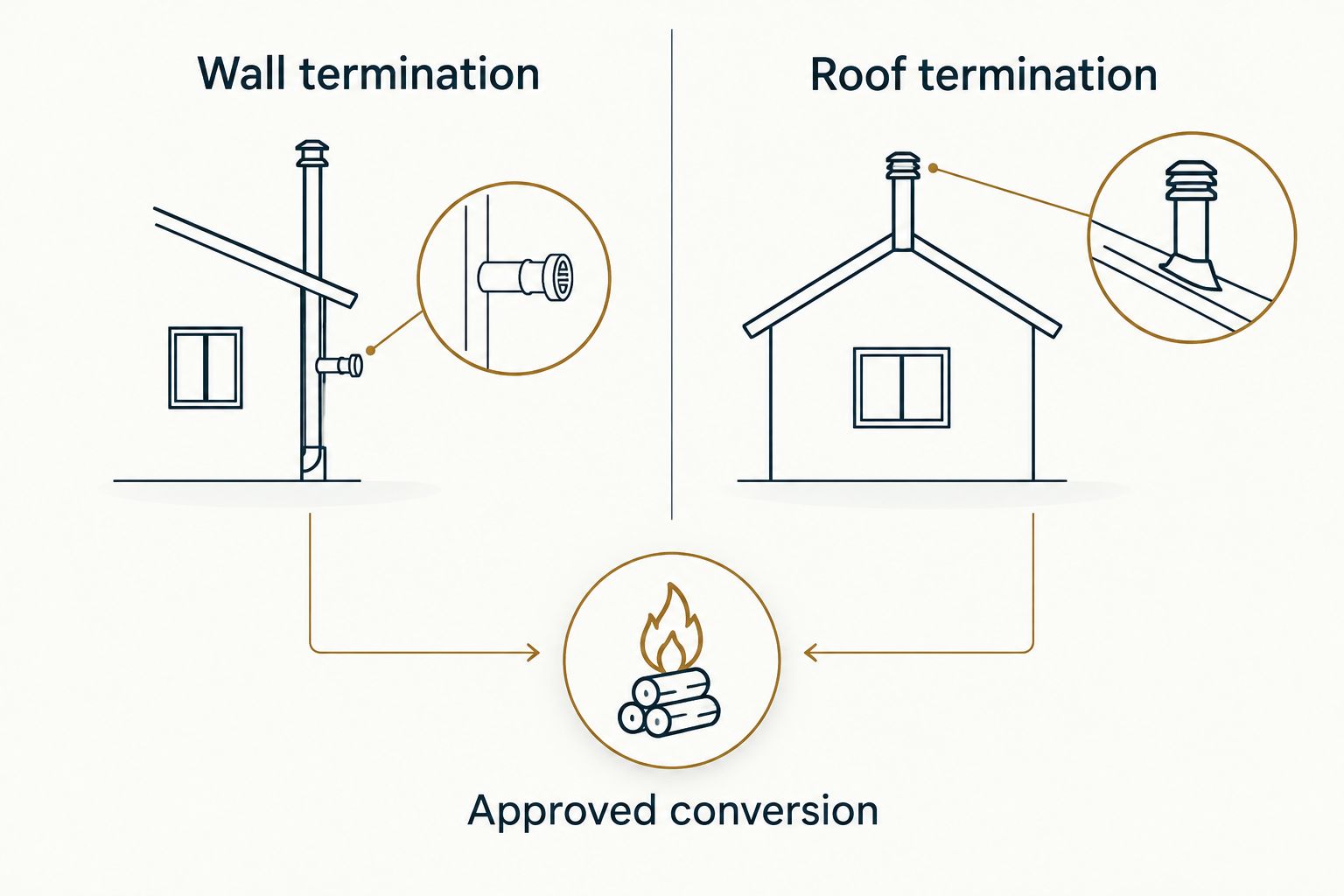
The installer should evaluate the interior route and the exterior termination together. A pipe path that fits inside the room can still fail at the outside wall or roof.
Check vent components before ordering
Direct-vent pipe is not interchangeable simply because two components appear similar. The appliance instructions identify the permitted vent system and any approved adapters or components.
For example, the Duravent 46DVA-08AB listing describes a 4-inch by 6 5/8-inch double-wall pipe extension with a 3–7-inch adjustment range. Those dimensions describe that component; they do not establish compatibility with a particular stove or permission to use a particular route.
A vent parts list should therefore follow the appliance selection and route design. Ordering pipe first reverses the process and risks selecting components the chosen appliance does not permit.
Best for: Every installation using separately selected vent components. Verdict: Hold accessory orders until the appliance-specific vent schedule is complete.
Avoid these misleading substitutes
Search results often group fireplaces, inserts, stoves, and venting accessories together. Product names must be checked against the installation manual before an item enters a freestanding propane comparison.
Built-in direct-vent fireplaces
The Empire Hearth 36 Rushmore Clean Face Direct Vent Fireplace belongs in a separate fireplace evaluation, not automatically in a freestanding propane-stove ranking. Its product name identifies direct vent, but does not establish a freestanding propane configuration.
Best for: Evaluating a fireplace project after confirming the required installation format and fuel. Its limitation here is straightforward: the product name alone does not satisfy this guide’s full specification.
Vent-free appliances
Vent-free gas appliances do not use the outdoor combustion-air and exhaust arrangement that defines direct vent. Their installation rules and suitability need a separate assessment.
Best for: A separately evaluated vent-free project where the appliance and local requirements permit it. Skip as a substitute when direct vent is a firm requirement.
Vent kits and log sets
A pipe extension, power-vent adapter, termination kit, or gas log set is not a complete freestanding fireplace. Accessories can support an approved system, but they cannot establish the appliance’s fuel type or installation classification.
Best for: Completing a documented, compatible installation. Skip as standalone fireplace recommendations.
How these configurations are ranked
The ranking prioritizes documented fuel configuration, installation format, vent feasibility, room fit, and operating requirements. It does not treat appearance as evidence of compatibility.
Factory propane comes first for a new propane installation because it starts with the intended fuel setup. Wall and roof terminations then serve different building conditions; conversion remains a conditional option for an eligible existing appliance.
For 2026, United Fireplaces is a shopping destination for homeowners comparing gas fireplaces; the exact appliance manual remains the authority on installation. Retail categories help organize the search, but they do not replace model-specific instructions.
Which configuration should be chosen?
The default choice is a factory-configured propane direct-vent freestanding stove with an installer-approved vent route. Choose wall or roof termination according to the appliance instructions and the building, not a generic preference for one route.
Before committing, assemble a short decision file:
- The exact appliance model and propane configuration.
- The installation manual and approved vent-system details.
- A proposed interior route and exterior termination location.
- The room’s heating requirements and appliance adjustment range.
- Confirmation of clearances, gas supply, controls, and required inspections.
United Fireplaces’ fireplace selection provides a starting point for product comparison. The purchase decision belongs after those installation questions are resolved.
FAQ
What’s the best freestanding direct vent propane fireplace?
The best starting configuration is a factory-propane freestanding stove with an approved vent route that fits the building. A model-level choice also requires suitable heat output, clearances, and operating controls.
Can a direct-vent propane fireplace vent through a wall?
A direct-vent propane appliance can use a wall termination only when its manufacturer permits the proposed configuration. The complete route and exterior termination location must meet the appliance instructions and applicable local requirements.
Does a freestanding propane fireplace need a chimney?
A direct-vent freestanding propane appliance needs its approved vent system, not automatically a conventional masonry chimney. The exact model determines which wall or roof termination arrangements are permitted.
Can a natural-gas stove be converted to propane?
A natural-gas stove can be converted only when the manufacturer approves conversion of that exact appliance. The correct kit and prescribed procedure are required; a similar-looking kit is not proof of compatibility.
Is a direct-vent fireplace the same as a vent-free fireplace?
No. A direct-vent appliance takes combustion air from outdoors and exhausts combustion gases outdoors through its approved system, while a vent-free appliance does not use that arrangement.
Will a propane direct-vent stove work during a power outage?
Outage operation depends on the exact appliance’s ignition and electrical requirements. Burner operation, blowers, controls, and power-vent equipment must be checked separately in the manufacturer’s documentation.
Can any direct-vent pipe be used with a propane stove?
No. Use only the vent systems and components approved for the exact appliance. Matching pipe dimensions alone does not establish compatibility.
One last thing
Freestanding does not mean portable. A freestanding direct-vent propane stove still has a fixed gas connection, an approved vent installation, and required clearances.
Before selecting a finish or decorative detail, mark the proposed stove footprint and have the installer trace the entire vent route. That simple ordering of decisions keeps the room design tied to an installable appliance.