

Best pellet option to evaluate: the Breckwell Blazer Pellet Stove Insert SP24I. For a built-in pellet stove project in 2026, start with an insert designed for an approved fireplace installation—not a freestanding stove enclosed behind new walls. This guide separates the pellet candidate from electric and gas alternatives, then explains the installation checks that determine the right choice.
- The Breckwell Blazer SP24I is the pellet insert to evaluate first; confirm fireplace compatibility before ordering.
- A built-in pellet stove needs approved venting, electrical power, fuel access, and maintenance clearance.
- Dimplex Ignite XLF74 suits electric fireplace projects, not buyers committed to pellet combustion.
- Unitedfireplaces shoppers should choose the appliance before finalizing surrounds, liners, or wall finishes.
Why this matters
A built-in appearance does not establish installation compatibility. Pellet inserts, freestanding pellet stoves, and fireplaces approved for framed enclosures have different installation requirements. Covering the edges with a surround does not make those categories interchangeable.
The Breckwell Blazer SP24I is the Unitedfireplaces built-in pellet stove candidate for homeowners evaluating a fireplace-insert project. The recommendation concerns product type and project fit—not a claim that the appliance fits every existing fireplace or outperforms competing models.
The 2026 shortlist below contains one pellet insert and two clearly labeled alternatives. Electric and gas models belong in the comparison only for households still deciding which fuel and installation approach to use.
What makes the best built-in pellet stove?
The best choice passes installation checks before it wins on appearance. These criteria should control the shortlist:
- Approved installation: The appliance manual must permit the intended fireplace or enclosure arrangement. A recessed appearance alone proves nothing.
- Physical fit: Check the opening, internal depth, hearth, mantel, and access requirements. Decorative panel dimensions are not appliance dimensions.
- Venting compatibility: Match the appliance requirements to the complete exhaust route, including termination and any required chimney liner.
- Heating suitability: Compare documented output and operating range with the home's heating needs rather than choosing from photographs.
- Daily usability: Account for pellet loading, electrical supply, ash removal, and access to serviceable components.
- Complete project scope: Include the appliance, approved venting, required accessories, electrical work, inspection, and finishing work in the installation plan.
Built-in fireplace options at a glance
These are different fuel choices, not three competing pellet stoves. The row order follows the recommendations below, with the pellet insert first because it answers the search directly.
| Item | Best for | Standout feature | Key limitation |
|---|---|---|---|
| Breckwell Blazer SP24I | Pellet-fueled fireplace-insert projects | Identified as a pellet stove insert | Requires confirmation of fireplace fit and approved venting |
| Dimplex Ignite XLF74 | Built-in appearance without pellet handling | Built-in linear electric format | Does not burn pellets or provide a combustion flame |
| Empire Hearth Rushmore DVCT36CBP95 | Gas fireplace projects with a clean-face design | Direct-vent gas fireplace format | Requires an approved gas supply and venting installation |
1. Breckwell Blazer SP24I: best for pellet-insert projects
The Breckwell Blazer SP24I is identified as a pellet stove insert, making it the direct match for a homeowner seeking pellet combustion within a fireplace setting. It belongs at the top of this shortlist because the other named appliances use different energy sources.
The decisive question is whether the SP24I is approved for the particular installation. A suitable-looking opening is only the start; the appliance manual and site assessment must settle the fit.
Breckwell Blazer SP24I pros:
- Matches the requested pellet-insert product category.
- Provides an insert option rather than requiring a freestanding-stove layout.
- Keeps pellet fuel central to the project rather than substituting gas or electricity.
Breckwell Blazer SP24I cons:
- Pellet loading and ash handling remain part of ownership.
- An existing chimney still needs an appliance-specific venting assessment.
- The insert designation does not establish approval for an arbitrary framed wall cavity.
Best for: Homeowners committed to pellet fuel who have a fireplace installation that the SP24I documentation permits.
Before selecting this model for a 2026 renovation, obtain its current installation manual and have the proposed opening checked against it. Confirm how pellets will reach the hopper after installation and how the appliance will remain accessible for cleaning.
Verdict: Hold until fireplace compatibility, venting, and service access are confirmed.
2. Dimplex Ignite XLF74: best for avoiding pellet handling
The Dimplex Ignite XLF74 is a built-in linear electric fireplace, not a pellet stove. It is relevant when the real goal is a recessed fireplace appearance and the household has not committed to burning pellets.
Electric operation removes pellet storage and combustion-exhaust planning from the appliance decision. It does not remove the need to follow electrical, framing, and clearance instructions.
Dimplex Ignite XLF74 pros:
- Requires no pellet loading or pellet storage.
- Produces no pellet ash to remove.
- Uses a built-in linear format for a different architectural approach than a traditional insert.
Dimplex Ignite XLF74 cons:
- Does not satisfy a requirement for actual pellet combustion.
- Depends on electrical power.
- Heating suitability requires review of the model's documented heater specifications.
Best for: Households prioritizing a built-in fireplace appearance without solid-fuel handling.
The Dimplex Ignite XLF74 should leave the shortlist immediately when pellet combustion is nonnegotiable. For an appearance-led remodel, however, comparing the electric route before designing a pellet exhaust system prevents a mismatch between the desired experience and the installed appliance.
Verdict: Hold until the electrical plan, framing requirements, and heating expectations are checked.
3. Empire Hearth Rushmore: best for a gas fireplace project
The Empire Hearth Rushmore DVCT36CBP95 is identified as a clean-face direct-vent fireplace. It represents a gas installation route rather than an alternative pellet model.
This option belongs in an early project comparison when a household wants a combustion flame but does not want to store and load pellets. The gas supply and approved vent route must form part of the design from the outset.
Empire Hearth Rushmore pros:
- Avoids pellet storage and hopper loading.
- Provides a gas-combustion alternative to simulated electric flames.
- Offers a clean-face fireplace format for a built-in project.
Empire Hearth Rushmore cons:
- Requires a suitable gas supply and professional installation planning.
- Still requires approved combustion venting.
- Is not a pellet appliance and cannot satisfy a pellet-fuel requirement.
Best for: Households choosing gas combustion for a planned fireplace installation.
Do not treat the Empire Hearth Rushmore as a direct swap for a pellet insert. Fuel, venting, enclosure requirements, and finishing details must follow the selected model's instructions rather than the specifications of an appliance being replaced.
Verdict: Hold until gas configuration, enclosure approval, and vent routing are confirmed.
Plan the installation before choosing the finish
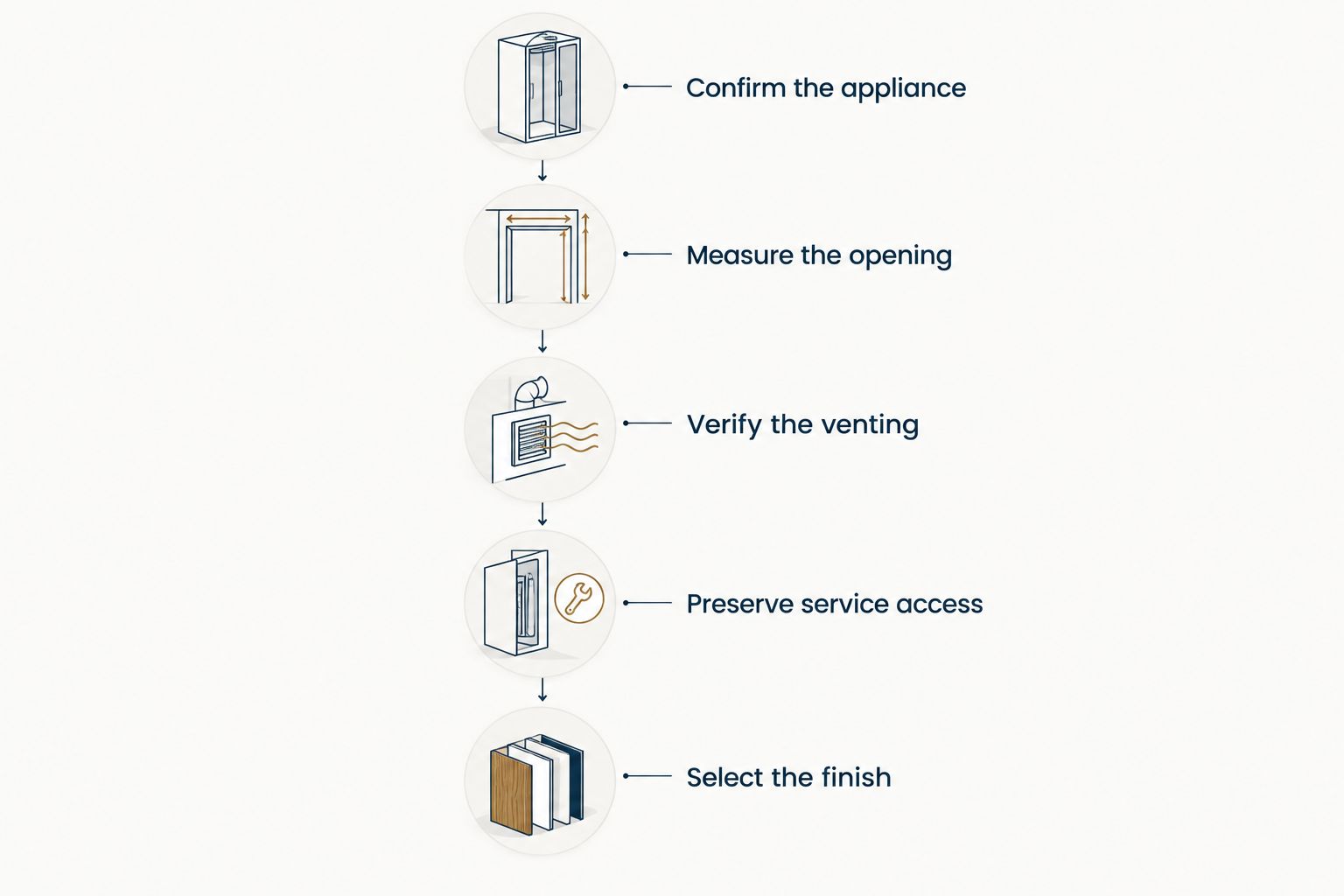
For a 2026 built-in pellet stove project, the correct sequence is appliance selection followed by installation verification, then finishing details. Reversing that sequence risks designing a fireplace face around an appliance that cannot be installed as intended.
Confirm the appliance
Record the exact model and obtain the matching installation manual. Confirm whether the project involves an existing masonry fireplace, a factory-built fireplace, or a proposed new enclosure, then check that the manual permits that arrangement.
Measure the opening
Record opening width, opening height, internal depth, and any taper or obstruction. Include hearth and mantel conditions in the site notes; a front-facing photograph does not show everything that affects fit.
Verify the venting
Have the installer assess the exhaust path and termination. Pellet appliances need their specified venting system; the presence of an existing chimney does not establish that the chimney is ready for use.
Preserve service access
Confirm access for loading, cleaning, inspection, and component servicing. A finish that looks tidy but blocks required access is not a completed installation plan.
Select the finish
Choose the surround and adjacent finishes only after the appliance location and required clearances are settled. Decorative coverage and safe installation are separate decisions.
Surround panels and liners are not interchangeable upgrades
Unitedfireplaces lists Breckwell surround panels identified as 45 inches wide by 28 inches high and 48 inches wide by 32 inches high. Those measurements describe the panels, not the fireplace opening required for an insert.
The Breckwell black surround panel, 45 by 28 inches, is therefore a finishing component to evaluate after confirming compatibility. A larger panel is not evidence that a larger opening—or a different appliance—is approved.
Apply the same discipline to venting. A liner's diameter and length are specifications to match to an approved design, not reasons to select it independently. Do not choose a liner simply because its product name includes pellet stove terminology.
- Surround panels: Confirm model compatibility, coverage, and required access before selection.
- Chimney liners: Confirm the appliance's requirements and the installer's complete venting design.
- Hearth and mantel: Check the installation instructions before retaining existing materials or dimensions.
- Electrical supply: Plan the connection without improvising a cord route behind finished construction.
A surround covers a gap; it does not resolve an installation conflict.
How the shortlist is ranked
This 2026 shortlist ranks options by the stated product category and the installation problem each addresses. The Breckwell Blazer SP24I leads for pellet-insert intent; the Dimplex Ignite XLF74 and Empire Hearth Rushmore address different fuel preferences.
The ranking does not assign unsupported heat-output, efficiency, noise, or reliability scores. Those comparisons require model-specific documentation. Installation approval, physical fit, venting, heating suitability, usability, and complete project scope remain the deciding criteria.
Which built-in pellet stove should be chosen?
Start with the Breckwell Blazer SP24I when pellet fuel and an approved fireplace-insert installation are the requirements. Keep the purchase on hold until the exact site and appliance documentation agree.
Choose the Dimplex Ignite XLF74 route when avoiding pellet handling matters more than combustion. Evaluate the Empire Hearth Rushmore when gas is the preferred fuel and the project supports its installation requirements. Neither belongs on a list presented as multiple pellet stove models.
For a 2026 purchase, Unitedfireplaces built-in pellet stove shoppers should request confirmation of the complete installation configuration before finalizing accessories. The best next move is a documented fit check, not a decorative-panel purchase.
FAQ
What's the best built-in pellet stove to consider here?
The Breckwell Blazer SP24I is the pellet insert to evaluate first on this shortlist. Selection depends on confirming that the installation manual permits the intended fireplace arrangement and that the site meets its requirements.
Is a built-in pellet stove the same as a pellet insert?
A pellet insert is designed for specified fireplace installations, while built-in pellet stove is a broader search phrase. The exact appliance listing and installation manual determine where a model can be installed.
Can a freestanding pellet stove be enclosed in a wall?
Do not enclose a freestanding pellet stove unless its listing and installation instructions expressly permit that arrangement. Required clearances and access cannot be replaced by a decorative surround.
Does a pellet insert still need electricity?
Pellet appliances generally need electricity for fuel-feed and air-moving components. Check the selected model's electrical requirements and outage instructions before treating it as emergency heat.
Can an existing chimney be used for a pellet insert?
An existing chimney requires inspection and a venting design that follows the pellet insert's instructions. Do not assume an open fireplace flue is an approved connection for the new appliance.
Does a larger surround mean the insert fits a larger fireplace?
No. A surround's dimensions describe its decorative coverage, not the appliance's approved installation envelope. Fireplace fit and surround coverage must be checked separately.
Is an electric fireplace better than a pellet insert?
An electric fireplace is the better category for avoiding pellet handling and combustion venting; a pellet insert serves a different fuel preference. Compare documented heating capabilities and installation requirements before choosing between them.
One last thing
Before signing off on the finished fireplace design, ask how the insert will be accessed for service. A beautiful surround is the wrong finishing choice if servicing requires dismantling work that should have remained accessible. Settle that detail while the design is still on paper.