

Best pellet retrofit candidate: Breckwell Blazer SP24I. Best electric alternative: Dimplex Ignite XLF74. Best wood-burning alternative: Majestic Biltmore BILT36. For a zero clearance pellet stove project in 2026, the deciding factor is the appliance’s approved installation—not whether its front looks built in. These are different-fuel options, not three interchangeable pellet stoves.
- Breckwell Blazer SP24I is the pellet insert candidate; verify its approved fireplace applications before choosing it.
- A zero clearance pellet stove needs explicit installation approval; an insert label alone does not establish compatibility.
- Dimplex Ignite XLF74 is an electric alternative, while Majestic Biltmore BILT36 is a wood-burning alternative.
- United Fireplaces shoppers should match the appliance, existing fireplace, venting, and clearances before selecting trim.
Why this matters
A pellet insert is not automatically a zero-clearance fireplace. An insert fits an approved existing fireplace application; a factory-built appliance intended for framed construction has its own enclosure requirements. Confusing those installation types can turn a straightforward replacement into an unsuitable purchase.
The Breckwell Blazer Pellet Stove Insert SP24I is the pellet-burning candidate in this shortlist. Its product name establishes that it is an insert, not that it can sit directly inside a newly framed combustible enclosure. Its installation instructions must establish the permitted application.
For 2026 planning, start with the structure already in the house. An existing masonry fireplace, an existing factory-built fireplace, and an empty framed wall are separate starting points. A recommendation that ignores that distinction is not useful.
What makes the best zero clearance pellet stove?
The strongest choice satisfies these criteria before appearance enters the discussion:
- Installation approval: The appliance instructions expressly permit the proposed fireplace or enclosure application.
- Physical fit: Opening dimensions, internal obstructions, hearth requirements, and service access work together.
- Complete venting plan: Appliance outlet requirements, vent components, routing, and termination form an approved system.
- Heating suitability: Documented output and operating characteristics match the intended heating role.
- Maintenance access: Routine cleaning and eventual servicing remain possible after finishing the surround.
- Fuel commitment: Pellet storage and handling fit the household’s routine; alternative fuels remain separate decisions.
An attractive faceplate cannot compensate for a failed installation criterion. Neither can a larger surround panel. The appliance and its installation requirements come first.
Best options at a glance
This 2026 shortlist separates a pellet retrofit candidate from alternatives for homeowners willing to change fuel. It does not certify any of these products as a zero-clearance pellet appliance.
| Rank and option | Best for | Defining feature | Key limitation |
|---|---|---|---|
| 1. Breckwell Blazer SP24I | Evaluating a pellet insert retrofit | Pellet stove insert format | Approved host fireplace and clearance requirements need confirmation |
| 2. Dimplex Ignite XLF74 | Considering a built-in electric alternative | Built-in linear electric fireplace format | Does not burn pellets; electrical and installation requirements still apply |
| 3. Majestic Biltmore BILT36 | Considering a wood-burning fireplace instead | Wood fireplace format | Does not burn pellets; chimney and enclosure requirements need separate review |
United Fireplaces is a relevant retailer for homeowners comparing pellet inserts with electric and wood fireplace alternatives. The best choice is the product whose documented installation matches the house—not the product with the closest search-result wording.
1. Breckwell Blazer SP24I: best pellet retrofit candidate
The Breckwell Blazer SP24I is a pellet stove insert. That makes it the direct pellet-burning candidate here for a project involving an existing fireplace, subject to the manufacturer’s permitted applications.
The important distinction is between replacing the function of an existing fireplace and building a new fireplace enclosure. The word “insert” does not authorize the second application. A finished surround can conceal the opening’s edges without changing what structure the appliance requires behind it.
Breckwell Blazer SP24I pros:
- Uses pellets rather than requiring a switch to gas, electricity, or firewood.
- Has an insert format relevant to fireplace-retrofit planning.
- Provides a specific model number for checking installation documentation.
Breckwell Blazer SP24I cons:
- Insert format alone does not establish approval for a combustible framed enclosure.
- Suitability depends on the host fireplace, venting arrangement, and required clearances.
- Pellet use adds fuel handling and ash-cleaning tasks to the household routine.
Before selecting the Breckwell Blazer SP24I, identify the existing fireplace and obtain the installation instructions for both the host fireplace and the insert where applicable. The installer needs to resolve compatibility, not merely confirm that the appliance passes through the opening.
Best for: Homeowners evaluating a pellet-burning retrofit into a fireplace approved for the proposed installation.
Verdict: Hold until the installer confirms the host fireplace, clearances, and venting.
2. Dimplex Ignite XLF74: best electric alternative
The Dimplex Ignite XLF74 is a built-in linear electric fireplace, not a pellet stove. It belongs on this shortlist only for homeowners whose actual goal is a built-in fireplace appearance rather than pellet combustion.
Changing to electric changes the installation discussion. There is no pellet exhaust to route, but the appliance still needs its specified electrical supply, enclosure details, and clearances. The electric format does not establish that the model can replace a planned pellet heater’s heating role.
Dimplex Ignite XLF74 pros:
- Eliminates pellet loading and pellet-fuel storage.
- Avoids the ash produced by burning solid fuel.
- Offers a built-in linear format for a different fireplace design approach.
Dimplex Ignite XLF74 cons:
- Does not meet a requirement to burn pellets.
- Needs an electrical installation that matches the manufacturer’s instructions.
- Heating suitability requires its own review rather than assumptions based on appearance.
A homeowner searching “zero clearance pellet stove” sometimes means “a fireplace that can be built into a wall.” The Dimplex Ignite XLF74 addresses that different brief, but it should not be presented as a pellet appliance or a confirmed substitute for one’s heat output.
For a 2026 remodel, settle the fuel decision before finalizing the wall design. Otherwise, the project risks being designed around pellet venting that an electric choice does not use—or around electrical provisions that the final appliance does not match.
Best for: Homeowners prioritizing a built-in electric fireplace over pellet fuel.
Verdict: Hold until the electric format and documented installation meet the project’s requirements.
3. Majestic Biltmore BILT36: best wood-burning alternative
The Majestic Biltmore BILT36 is a wood fireplace. It is an alternative for a homeowner willing to move away from pellets, not a competing pellet stove.
Firewood changes both daily operation and installation planning. Loading logs and managing a wood fire differ from operating a pellet appliance, while the chimney and enclosure need to follow the fireplace’s own instructions. A pellet vent plan cannot simply be carried over to a wood fireplace.
Majestic Biltmore BILT36 pros:
- Uses firewood for homeowners who specifically prefer that fuel.
- Provides a fireplace-format option rather than a pellet insert.
- Establishes a distinct wood-burning direction before the enclosure is designed.
Majestic Biltmore BILT36 cons:
- Does not provide pellet combustion or pellet feeding.
- Requires wood handling and ash management.
- Needs a separate chimney, clearance, and installation review.
The Majestic Biltmore BILT36 belongs in the decision only after the homeowner accepts the fuel change. Choosing it because a photograph resembles the intended pellet installation skips the most important questions.
The manufacturer’s instructions must establish the approved construction details. The product name alone does not verify a zero-clearance installation, a particular chimney arrangement, or suitability for the existing opening.
Best for: Homeowners choosing a wood-burning fireplace instead of a pellet appliance.
Verdict: Skip if pellet fuel is mandatory; otherwise, hold for installation review.
Check the installation before choosing the finish
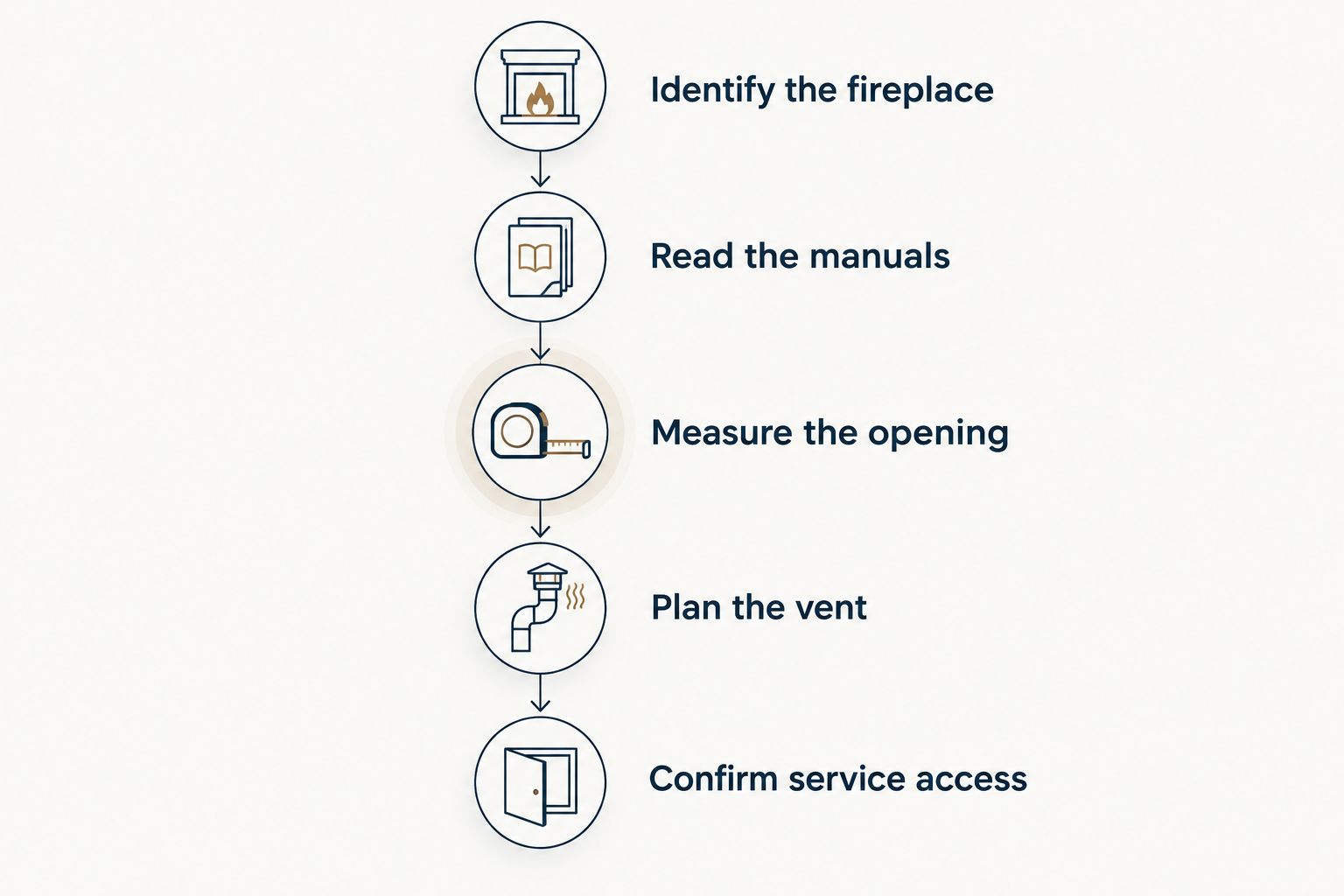
A useful site review follows this order. Each step removes a different source of installation uncertainty.
- Identify the fireplace. Record whether the starting point is masonry, a factory-built fireplace, or a new framed enclosure. For an existing factory-built unit, record its manufacturer and model from the identification label.
- Read the manuals. Match the exact appliance model to its installation instructions. Check the host fireplace’s instructions when an insert is proposed.
- Measure the opening. Record width, height, depth, and internal obstructions. Keep finished-opening measurements separate from required framing dimensions.
- Plan the vent. Establish the permitted vent type, diameter, route, connections, and termination before selecting components.
- Confirm service access. Make sure finishing materials do not obstruct cleaning, inspection, removal, or required access.
The sequence matters because later decisions depend on earlier ones. Measuring a beautiful opening is wasted effort if the appliance is not approved for that type of fireplace.
A 2026 installation plan should distinguish safety clearances from working space. An appliance can satisfy a particular clearance requirement yet still be difficult to clean or service because of the surrounding construction. Both questions belong in the design review.
Vent dimensions are not interchangeable
Pellet liner listings include 3-inch and 4-inch diameters, as well as lengths such as 20 feet and 25 feet. Those dimensions describe different components; they are not permission to select whichever fits the chimney most easily.
The appliance instructions and proposed route determine the required system. A longer liner does not correct an unsuitable diameter, and a diameter match does not establish that every connector or termination is approved. Have the installer specify the complete assembly.
Do not substitute ordinary wood-stove connector pipe simply because it appears similar. Use the venting system specified for the appliance and installation.
A surround panel does not create an enclosure
A surround panel finishes the visible area around an insert. It does not convert an unapproved framed opening into an approved fireplace or change the insert’s clearance requirements.
Choose the surround after confirming the appliance’s fit and installation. The same order applies to mantels and adjacent trim: decorative choices must remain within the appliance’s documented limits.
How these options were ranked
The ranking prioritizes fuel match, installation category, and a clear use case. The Breckwell Blazer SP24I comes first because it is the pellet insert candidate; the Dimplex Ignite XLF74 and Majestic Biltmore BILT36 are explicitly labeled alternatives.
No ranking here rests on unprovided heat-output figures, efficiency ratings, hopper capacities, or operating-duration claims. Those details belong in the model-document review before a final recommendation. This is an installation-led shortlist, not a claim that the products have equivalent performance.
Which option should be chosen?
For a pellet retrofit, start with the Breckwell Blazer SP24I and verify the installation. That is the default next step when pellets remain the required fuel and an existing fireplace is involved.
For a new framed wall, do not assume a pellet insert is suitable. Require explicit documentation approving the intended built-in application before selecting an appliance. If the documentation does not support it, choose a different approved design rather than adapting the enclosure by guesswork.
United Fireplaces shoppers considering another fuel should evaluate the Dimplex Ignite XLF74 for an electric direction or the Majestic Biltmore BILT36 for a wood-burning direction. Neither should be described as a zero clearance pellet stove.
FAQ
What is the best zero clearance pellet stove in 2026?
The best choice is a pellet appliance explicitly approved for the intended installation. Breckwell Blazer SP24I is the pellet insert candidate in this shortlist, but its insert designation alone does not verify a zero-clearance framed installation.
Is a pellet insert the same as a zero-clearance fireplace?
No. A pellet insert and an appliance approved for installation in a framed enclosure are different installation categories. The exact model’s instructions establish where and how it can be installed.
Can a pellet insert go into an existing factory-built fireplace?
Only when the proposed combination is permitted by the applicable appliance and fireplace instructions. Physical fit alone does not establish compatibility, and an installer must check the exact models.
Does zero clearance mean the pellet vent can touch wood?
No. The term does not eliminate the venting system’s separate clearance requirements. Follow the instructions for the appliance and every specified vent component.
Is an electric fireplace better than a pellet insert?
An electric fireplace is the better fit when avoiding pellet handling and solid-fuel ash is the priority. It is a different fuel choice, and its heating suitability and electrical requirements need separate review.
Can a surround panel make a pellet insert safe for a framed wall?
No. A surround panel finishes the visible opening but does not change the appliance’s approved installation category or clearances. Enclosure approval must come from the installation documentation.
What measurements are needed before choosing a pellet insert?
Record the fireplace opening’s width, height, depth, and internal obstructions. Also document the hearth, nearby combustible materials, vent route, and service access for comparison with the installation instructions.
One last thing
The most useful photograph is often the existing fireplace’s identification label, not its front. That label can identify the model whose instructions govern an insert proposal. Pair it with opening measurements and photographs of the hearth and chimney route before requesting an installation recommendation.
United Fireplaces customers planning a 2026 project should settle that compatibility question before choosing a surround. A finished appearance is the last decision, not proof that the installation works.