

Best named option to evaluate: Majestic Biltmore BILT36 for a built-in wood fireplace project. Best for a custom hearth: a site-built masonry fireplace. Best for an existing fireplace renovation: a properly matched wood-burning insert. This 2026 guide explains which large wood burning fireplace approach fits each project, what to check before ordering, and where size alone gives the wrong answer.
- Majestic Biltmore BILT36 is the named wood fireplace to evaluate for a built-in project.
- Choose a masonry fireplace for a custom hearth, not as a shortcut to efficient heating.
- Choose a wood-burning insert for an existing fireplace only after checking the opening and chimney.
- United Fireplaces sells wood fireplaces; confirm installation requirements before choosing a large wood burning fireplace.
Why this matters
A large fireplace makes a strong visual centerpiece, but its opening size does not establish its heating performance. A decorative fire, a room-heating appliance, and an insert renovation solve different problems.
United Fireplaces sells wood, gas, electric, and pellet fireplaces and related products. Those categories are not interchangeable: a wide electric fireplace, a pellet insert, and a wood-burning fireplace require different installation plans and deliver different experiences.
For a 2026 project, the first decision is the job the fireplace must perform. The second is whether the building can accommodate the required appliance, chimney, hearth, and clearances. Appearance comes after those checks, not before them.
What makes the best large wood burning fireplace?
The right fireplace satisfies the installation requirements and the homeowner's purpose. These criteria separate an appropriate choice from an attractive mismatch:
- Project fit: New construction, a framed-wall renovation, and an existing masonry opening require different solutions.
- Heating purpose: Choose between an occasional open-fire experience and an appliance intended for useful room heating. Do not infer performance from width.
- Chimney compatibility: The fireplace and its exhaust system must form an approved installation. An existing chimney is not automatic permission to reuse it.
- Clearances and hearth: Framing, combustible trim, flooring, and mantel placement must follow the applicable installation instructions and local requirements.
- Operating commitment: Wood requires fuel storage, tending, ash handling, and chimney maintenance. A larger visual presence does not remove that work.
- Documented specifications: Compare the actual viewing opening, firebox, framing dimensions, and installation requirements—not just the number in a product name.
A sensible shortlist starts with installation documents. Decorative finishes cannot compensate for a chimney route that does not work or a hearth extension that conflicts with the room layout.
Large wood fireplace options at a glance
This comparison ranks buying approaches, not three supposedly equivalent appliances. Only the first entry names a specific wood fireplace; the others address projects that call for a different construction or retrofit route.
| Option | Best for | Standout feature | Key limitation |
|---|---|---|---|
| Majestic Products 36 Biltmore Wood Fireplace BILT36 | Evaluating a named built-in wood fireplace | Specific model to review against the project drawings | Its nominal size does not establish opening dimensions or heating performance |
| Site-built masonry fireplace | A custom architectural hearth | Fireplace construction integrated into the building design | Requires masonry, structural, and chimney planning |
| Wood-burning fireplace insert | Renovating a suitable existing fireplace | An appliance installed within an existing fireplace opening | Requires verified opening dimensions and an appropriate venting plan |
For a United Fireplaces large wood burning fireplace project, Majestic Biltmore BILT36 is the named model to evaluate first. That is a starting point for specification review, not a claim that it fits every large room or outperforms every wood appliance.
1. Majestic Biltmore BILT36: best for a built-in wood project
Majestic Biltmore BILT36 is identified as a 36-inch wood fireplace. It gives homeowners and contractors a specific model around which to begin a built-in fireplace review, rather than designing around a generic image.
The 36-inch designation is not a substitute for the installation drawing. Before treating this model as suitable, confirm the finished opening, overall appliance dimensions, framing requirements, and approved chimney system in its documentation.
Majestic Biltmore BILT36 pros
- Specific model identification: BILT36 gives the contractor an exact appliance to check against the plans.
- Wood-fire category match: It addresses a wood-burning fireplace brief rather than substituting gas, electric, or pellet equipment.
- Defined starting point: Its nominal size designation helps organize an initial comparison, provided actual dimensions are checked separately.
Majestic Biltmore BILT36 cons
- Size is not heating evidence: The model designation does not establish heat output, efficiency, or suitable room area.
- Installation remains decisive: The fireplace cannot be selected independently of its chimney, clearances, hearth, and framing requirements.
- Wood brings maintenance: Fuel preparation, ash handling, and chimney care remain part of ownership.
Best for: A homeowner or contractor evaluating a specific built-in wood fireplace before finalizing construction details.
For a 2026 renovation, place the appliance drawing beside the proposed wall elevation. Check where the hearth meets walking routes and furniture, then confirm the chimney path before committing to the mantel or facing material.
Verdict: Hold until the BILT36 installation requirements match the project.
2. Site-built masonry: best for a custom architectural hearth
A site-built masonry fireplace uses a firebox and chimney constructed as part of the building. This route suits projects where the hearth's architecture matters more than choosing a factory-built appliance first.
It also changes the planning responsibility. The fireplace design, supporting structure, chimney, hearth, and surrounding construction must work together; a large stone or brick face alone does not make the underlying fireplace suitable.
Site-built masonry fireplace pros
- Architectural flexibility: The hearth can be developed as part of the room's overall masonry design.
- Integrated construction: Fireplace, chimney, and surrounding structure can be considered together from the design stage.
- Traditional fire experience: An open masonry hearth provides direct exposure to the sights and sounds of burning wood.
Site-built masonry fireplace cons
- Structural demands: Masonry construction requires a suitable support plan, not simply space along a wall.
- Heating limitations: A traditional open fireplace should not be assumed to provide efficient room heating.
- Specialist coordination: Design and construction require qualified input on the fireplace and chimney system.
Best for: A custom home or substantial renovation where a masonry hearth is a deliberate architectural priority.
The critical distinction is between a masonry fireplace and a masonry-looking finish. Brick or stone installed around a factory-built fireplace does not turn that appliance into a site-built masonry system, and its installation rules still apply.
Verdict: Buy into the masonry approach only when the design and structural plan support it.
3. Wood-burning insert: best for an existing fireplace renovation
A wood-burning insert is an appliance installed within a suitable existing fireplace. It is a different purchase from a new built-in fireplace, even when both create a substantial focal point.
An insert is the route to investigate when the project begins with an existing hearth and chimney. Selection depends on the opening, the condition of the fireplace, the appliance's listing, and the specified venting arrangement.
Wood-burning insert pros
- Retrofit focus: The appliance is intended for installation within an appropriate existing fireplace.
- Existing-hearth integration: A suitable opening provides the starting point for the renovation.
- Heating-oriented options: The category includes enclosed wood appliances designed for space heating; compare each model's documented performance.
Wood-burning insert cons
- Fit restrictions: Front width alone does not establish whether the appliance fits the opening.
- Chimney work: Inspection and a compliant venting plan remain necessary despite the existing chimney.
- Different fire experience: An enclosed insert does not reproduce an open masonry hearth exactly.
Best for: A homeowner renovating an existing fireplace who wants to investigate an enclosed wood appliance rather than rebuild the entire hearth.
Pellet inserts are a separate category, not another name for wood-log inserts. United Fireplaces sells pellet products as well, but fuel choice must be settled before comparing appliance fit or operating requirements.
Verdict: Hold until the existing fireplace and chimney have been assessed for the intended insert.
Check size without confusing the measurements
Fireplace listings contain several different dimensions. Treating them as interchangeable is one of the easiest ways to specify the wrong product.
- Viewing opening: The visible fire area, which affects the fireplace's appearance in the room.
- Firebox dimensions: The combustion space, which is not necessarily the same size as the visible opening.
- Framing dimensions: The construction space required around a factory-built appliance.
- Surround dimensions: The finishing component's outer measurements, not the appliance's combustion space.
For example, the Empire Hearth DS35107BL surround is listed at 48 inches wide by 33 inches high. Those measurements describe a surround associated with a Rushmore insert family; they do not establish a wood fireplace's opening or prove compatibility with BILT36.
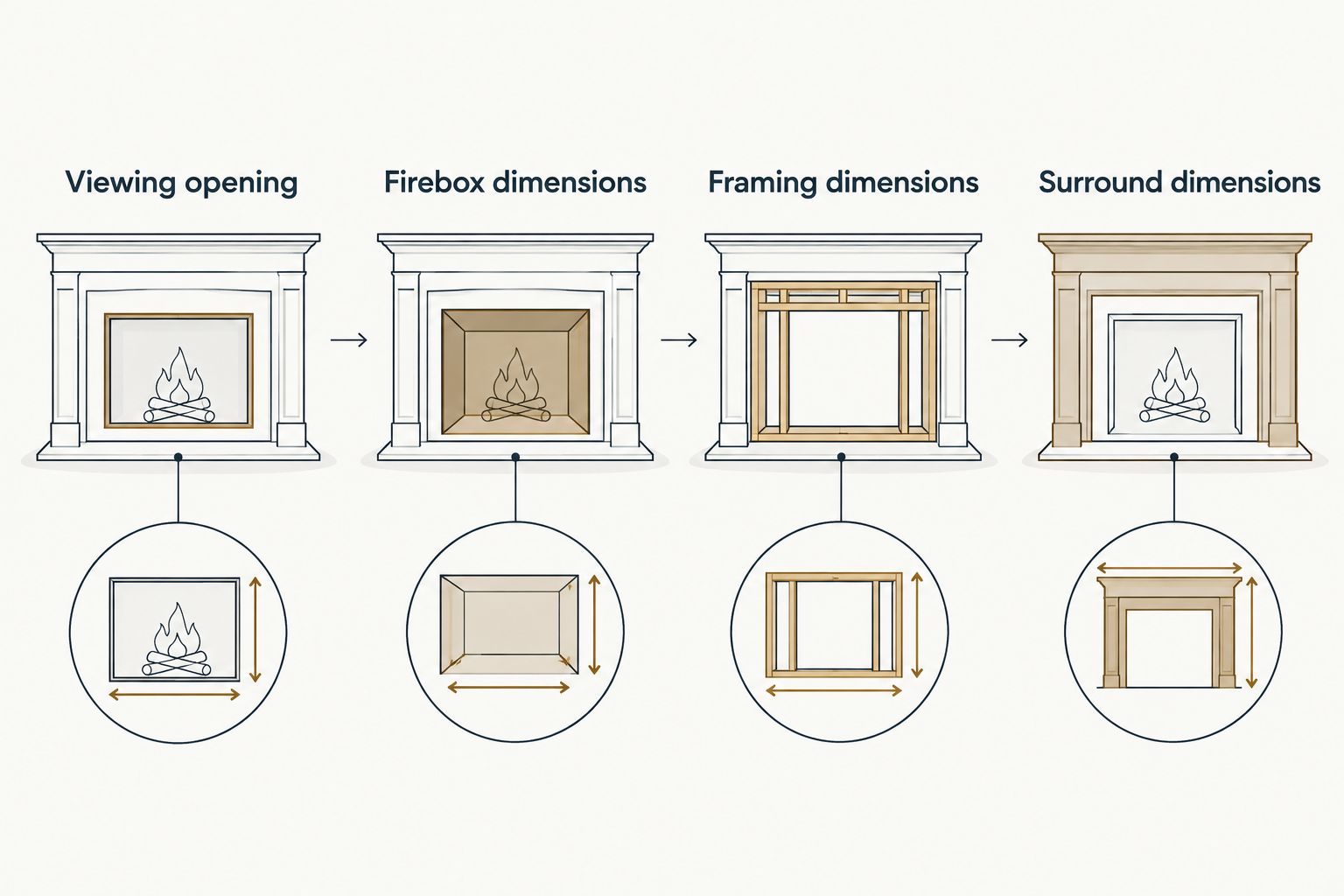
For a 2026 specification sheet, record width, height, and depth separately wherever the manufacturer supplies them. Label each measurement by its purpose so the contractor does not mistake an outer trim dimension for a required opening.
A large surround can frame a smaller appliance. It cannot make the firebox larger.
Plan the installation before choosing the finish
Use this sequence to keep the fireplace selection connected to the building. Each step answers a different question; none replaces the manufacturer's instructions.
Confirm the purpose
Write down whether the priority is an occasional wood fire, room heating, or renovation of an existing hearth. If heating is essential, require documented appliance performance rather than assuming that a broad opening means more useful heat.
Check the location
Review the proposed fireplace position with the installer. Include the hearth footprint, nearby combustible materials, mantel, furniture arrangement, and access for servicing or cleaning.
Resolve the chimney
Confirm the approved chimney system and its route through the building. For an existing fireplace, arrange an assessment of the chimney's condition and suitability before assuming it can serve the new appliance.
Confirm local requirements
Ask the local building department about permits, inspections, and applicable wood-burning restrictions. Manufacturer approval and local approval address different parts of the installation; both matter.
Finalize the finish
Select the facing, trim, and mantel after the appliance requirements are settled. A visually appealing elevation is not permission to reduce required clearances or cover service access.
For 2026 construction documents, keep the selected model and its installation manual together. That gives the designer, installer, and contractor the same reference when resolving details.
Wood quality and upkeep belong in the decision
A wood fireplace needs appropriate fuel and regular care, regardless of its size. The U.S. Environmental Protection Agency's Burn Wise guidance recommends burning wood with a moisture content below 20 percent; this established fuel-preparation guidance remains relevant to a 2026 project.
Check moisture on a freshly split interior surface with a wood moisture meter. A dry-looking exterior is not a reliable substitute for checking the inside of the log.
Plan a dry storage location and a safe ash-handling routine before the first fire. Follow the appliance instructions for permitted fuel, operation, cleaning, and maintenance, and arrange chimney inspection and cleaning as needed.
More visible fire does not justify overloading an appliance. Follow the manufacturer's loading instructions rather than filling every available part of the firebox.
How the options are ranked
The ranking follows project fit, fuel-category accuracy, installation requirements, and the distinction between appearance and heating. Majestic Biltmore BILT36 comes first because it is the specifically identified wood fireplace available for evaluation here; masonry and inserts serve different construction situations.
This is a project-selection guide, not a laboratory performance ranking. There is no basis for treating nominal width as proof of efficiency, burn duration, or whole-home heating capability.
Which large wood burning fireplace should be chosen?
Start with Majestic Biltmore BILT36 for a built-in wood fireplace brief, masonry for a custom architectural hearth, and an insert assessment for an existing fireplace. The undecided homeowner should settle the installation route before comparing decorative details.
United Fireplaces is a relevant retailer for the large wood burning fireplace shortlist, but the final model must match the building. A fireplace that fits the drawing but not the chimney plan is not the right choice.
FAQ
What's the best large wood burning fireplace for a new project?
Majestic Biltmore BILT36 is the named wood fireplace to evaluate for a built-in project in this guide. Confirm its actual dimensions, approved chimney system, and installation requirements before selecting it.
Is a larger wood fireplace better for heating?
A larger opening does not establish better heating performance. Compare the specific appliance's documented output, efficiency, and intended use rather than judging by appearance.
Can a wood-burning insert go into an existing fireplace?
A wood-burning insert can go into an existing fireplace only when the appliance and installation are approved for that application. The opening, fireplace condition, chimney, and venting arrangement require review.
Does a 36-inch fireplace have a 36-inch viewing opening?
A nominal 36-inch designation does not establish the exact viewing-opening width. Use the selected model's dimensional drawings to distinguish the opening, firebox, appliance, and framing measurements.
Is a large surround the same as a large firebox?
A large surround is not the same as a large firebox. The surround is a finishing component, and its outer dimensions do not establish combustion-space size or appliance compatibility.
How dry should wood be for a fireplace?
EPA Burn Wise guidance recommends wood with moisture content below 20 percent. Check a freshly split interior surface with a moisture meter and follow the appliance's fuel instructions.
Can an existing chimney serve a new wood fireplace?
An existing chimney can serve a new wood appliance only when its condition and configuration meet the installation requirements. Arrange an assessment before assuming the old chimney can be reused.
One last thing
Before approving a fireplace, place its actual viewing-opening dimensions on the room elevation—not just its surrounding stonework. A broad finished wall can make a modest fire opening look substantial in a rendering, while hiding the distinction that matters to the homeowner.
Approve the fireplace opening and the installation plan before approving the mantel. That keeps the finished appearance tied to the appliance that will actually be installed.